
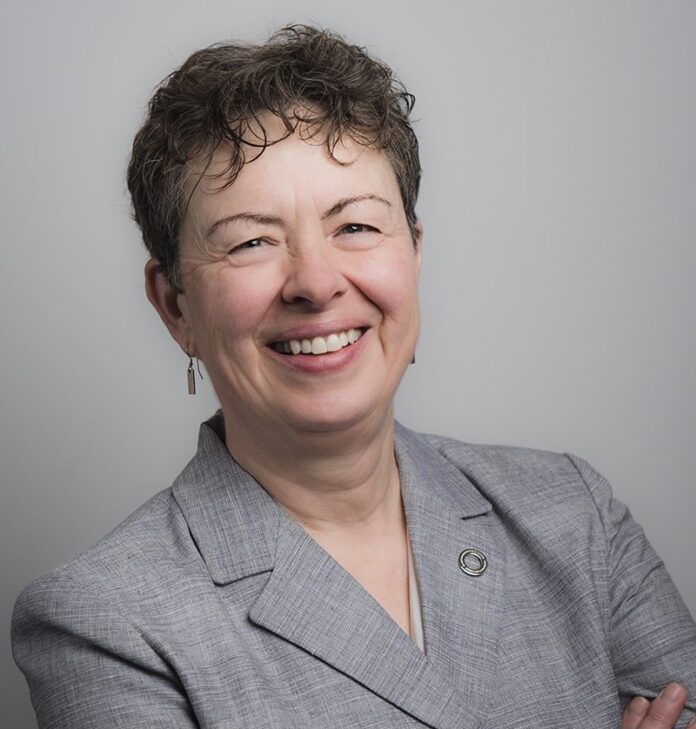

University of Alberta nursing professor Carole Estabrookswatched in helpless horror as the disaster that decades of her research had predicted began to unfold around the world.
“The day I heard on the news about the first case of COVID-19 in long-term care in Washington State, I knew it was over — that it was here and we couldn’t stop it,” Estabrooks remembers.
Nowhere did the new scourge hit harder than in Canada. Within the first six months of the pandemic, long-term care residents accounted for 81 per cent of all reported COVID-19 deaths, the highest in any OECD country.
“I turned on the news in May 2020, and soldiers were carrying bodies out of care homes in Ontario and Quebec,” says Estabrooks. “I wept that day. I thought, ‘My God, how bad is it really, if they’ve called in the army?’ Because I knew it was likely much worse than they were showing.”
For Estabrooks, the tragedy wasn’t just a medical crisis; it was a moral failure. As head of Translating Research in Elder Care and a Canada Research Chair for 24 years, she had sounded the alarm for years. Her work had shown that long-term care residents were suffering from treatable symptoms during their last year of life, many in serious pain, with care staff missing critical tasks because they simply didn’t have time to do them.
In April 2020 she said of long-term care, “We’ve been holding it together with duct tape.” And she knew the tape had finally snapped.
The day I heard on the news about the first case of COVID-19 in long-term care in Washington State, I knew it was over — that it was here and we couldn’t stop it. Carole Estabrooks
A flaw in Canadian values
While Estabrooks, who also has a cross-appointment to the School of Public Health, spent years showing why Canada’s nursing homes would be defenceless against a pandemic like COVID-19, her warnings, and those of others, went unheeded.
“COVID hurt the marginalized, the disenfranchised, the vulnerable,” says Estabrooks, looking back now. “How did we let this happen? At its core, it was because we do not value old people, especially old people with dementia. And that offends me.”
This sense of outrage fuelled what Estabrooks calls her “mission.” She grew up in a small town in New Brunswick, where her father was a labourer and her mother a teacher turned linotype setter. At first she thought she wanted to be a journalist but she chose nursing instead after meeting Margaret McPhedran, dean of nursing at the University of New Brunswick, who explained that nursing was a calling.
“She said, ‘One day you’re going to be old and you’re going to look in the mirror, and you want to like who looks back,’” Estabrooks remembers. “That comes from keeping your bead on something that’s important.”
After nursing in hospitals in New Brunswick, British Columbia and Alberta, Estabrooks caught the research bug while doing her master’s degree at the U of A. She viewed research as a form of detective work, rewarded by curiosity and tenacity. Her PhD and post-doctoral work focused on implementation science — turning academic evidence into real-world clinical changes.
“I was driven. I wanted to make things better,” she recalls.
The invisible workforce
A cornerstone of Estabrooks’ work is a focus on the people who provide the care. When she began, there was virtually no data on this workforce, particularly the health-care aides who provide 90 per cent of direct hands-on care.
“Why would we need data on them? They were unregulated and at the bottom of a pretty rigid hierarchy,” she recalls. Her research showed that in urban areas like Calgary and Edmonton, 80 per cent of aides are immigrant women who speak English as a second language.
Estabrooks points out that long-term care is a “highly feminized” sector, which she argues contributes to its lack of funding and public attention.
“Women’s work continues to be non-valued,” says Estabrooks, who is a member of the Women and Children’s Health Research Institute. “The undercurrent is that it’s ‘just domestic work’ — how hard can it be? But they do a tremendous amount of emotional and physical labour.”
Because health-care aides are the ones closest to the residents, Estabrooks realized they were key to any real improvement. But change was slow.
“What I thought would take five years took 15,” she admits. “It took over a decade to gather enough data on this workforce to begin designing interventions.”
The long road to recovery
When the pandemic hit, Estabrooks sprang into action. She was appointed to chair the Royal Society of Canada Task Force on COVID-19, producing a report with nine urgent recommendations, including national standards for staff, better infection controls, and improved training, pay and benefits for caregivers in long-term care facilities.
She also advised the Government of Canada on national long-term care standards, introduced in 2023. Although the promised Safe Long-Term Care Act has not materialized, the standards are now part of Accreditation Canada’s criteria. Alberta became the first province in the country to regulate health-care aides, introducing mandatory standards of practice, a code of ethics, a formal complaints process and a public registry — a long-overdue recognition, Estabrooks says, of a workforce that is central to quality of life for older adults in care homes.
She also wrote opinion pieces, made public presentations and did as many media interviews as she could manage, sharing what she knew with the general public.
“I knew that COVID opened a window for long-term care, and it would not be open very long,” she says. “People were shocked because they just hadn’t paid attention. We’re still doing work related to the attempts to recover from it.”
Despite the policy wins, the scars of the pandemic remain deep. Estabrooks notes that long-term care managers in particular took a “brutal beating” during COVID, and their mental and physical health has not yet recovered.
How did we let this happen? At its core, it was because we do not value old people, especially old people with dementia. And that offends me. Carole Estabrooks
“We’re not ready for another pandemic,” she warns bluntly. “Long-term care is a heavy human and relational endeavour — high touch, low tech. When people are under chronic duress, not only is their own health adversely affected, but long-term care homes experience higher staff turnover, which makes it harder to deliver quality care. High turnover is expensive on multiple levels, and successful retention strategies require sustained effort and adequate resources.”
A vision for the future
Estabrooks continues to push forward with her research program to highlight inadequacies and develop solutions for long-term care. She is now leading two studies on trauma-informed care and how to build resilience among managers.
One of her personal wins is that long-term care operators, both public and private, have supported her work over the decades, realizing their neglected area of the health-care system could benefit from evidence-informed attention.
“For me, that is perhaps the most personally rewarding thing — the people who do this really honourable work with the families and the residents have this level of trust in us,” she says. “They see we are trying to help. They see that our team cares and is in it for the long haul.”
As she looks toward the future of the U of A’s nursing program, Estabrooks is heartened by her own trainees and a “promising young cadre” of new assistant professors who are eager to bridge the gap between research and practice, particularly in the field of aging.
She is grateful for the 24 years of support from the Canada Research Chairs program, Canada’s highest academic appointment, which allowed her to devote 75 per cent of her time to research and introduced her to a community of others at the top of their fields. It bolstered her credibility as she applied for numerous grants from the Canadian Institutes of Health Research and other funding bodies.
Carole Estabrooks was named to the Order of Canada in 2016 and is a fellow of both the Canadian and American academies of nursing. She is a member of the Canadian Academy of Health Sciences, the International Nurse Researcher Hall of Fame and the Royal Society of Canada.
She advocates for a society-wide return to programs akin to ParticipACTION focused on older adults — encouraging physical activity and better nutrition in midlife to delay the onset of dementia, frailty and chronic disease — thereby enabling longer independent living.
Ultimately, her focus remains on the dignity of people in their final chapter of life. She points out the stark inequality in Canadian care for older adults who experience dementia or severe frailty: while those with enough resources may be able to afford private care at home, most Canadians in those circumstances must rely on long-term care and the goodness of strangers.
“People deserve to die with peace and have moments of joy,” she says. “They do not deserve to die suffering, lying in their diapers, in pain. It is not, of course, like that across the board, and the staff who work in long-term care do care deeply.’
“But if COVID showed us anything, it was the tragic impact of decades of under-investment in long-term care homes and older Canadians in general.”
BY GILLIAN RUTHERFORD