

At Toronto Rehab, embracing the risk of a fall may actually be part of a patient’s recovery journey.
That’s because experts are promoting the concept of therapeutic falls: a fall that takes place in the hospital – while a patient is practicing higher-risk activities they’ll need to perform at home – where the benefit of practicing outweighs the risk of falling.
In the journal Disability & Rehabilitation, Toronto Rehab experts argue that, unlike other falls prevention programs aiming to achieve zero falls, hospitals embracing the concept of therapeutic falls may better prepare patients for a safe transition home.
“We would rather patients take mediated risks in a rehab setting and let us teach them how to prevent the next fall than be discharged home and take a tumble there,” says Dr. Meiqi Guo, Medical Director of Toronto Rehab’s Brain Rehabilitation Program.
A concept built on trust and shared decision-making with patients
The concept of therapeutic falls was first piloted on Toronto Rehab’s Brain Injury Rehab Inpatient Service with patients who demonstrated a desire to push boundaries; were on the cusp of achieving a goal they’d need to perform at home, such as transferring from bed to a wheelchair; and could understand and appreciate the risk of falling.
“They’re the ones who make our hearts beat a bit faster,” says Angie Andreoli, physiotherapist and Innovations Lead, Safety & Quality.
“They’re so close to achieving their goal, we can tell they’re itching to reach out and grab it … but they’re not quite there yet. We see it as our duty to meet them where they’re at, because patients shouldn’t be making decisions about risk-taking alone.”
Therapeutic falls is a concept built on trust and shared decision-making between patients and their care team.
It starts with engaging a patient, and exploring the risks and opportunities associated with practicing certain activities on their own related to mobility.
“I need to be able to look my patient in the eye and essentially say ‘we know you want to move on your own, so let’s go down this path together. Yes, you might fall. But here are all the ways we can prevent a fall together,'” says Angie.
Key to this work is the emphasis on education around falls prevention and mitigation. If a fall does happen, the patient knows what to do next to prevent further harm.
“This work is not so much a practice change, but a shift in philosophy about how we discuss, communicate and learn from falls,” says Angie.
Identifying appropriate times to push boundaries
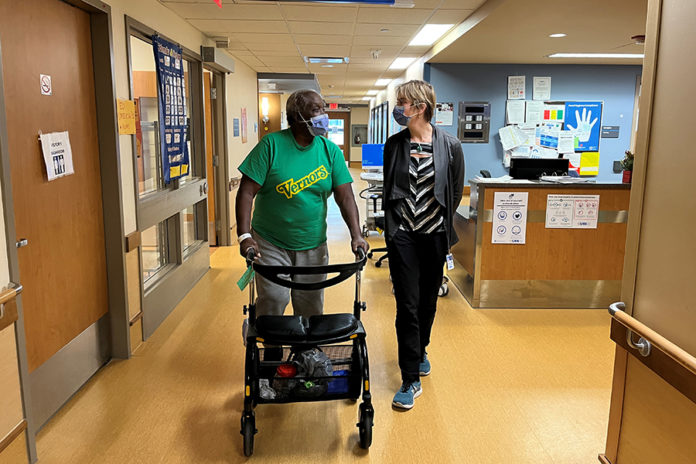
George Barrett isn’t the kind of patient to stay idle.
“I’m a fast-going person,” says the 75-year-old retired mechanic, who is recovering from a brain injury. “I don’t want to lay around, if I can be moving.”
Together with Angie, he’s been identifying appropriate times to push boundaries, as he prepares for discharge.
For George, that means walking independently for the first time since his injury and subsequent surgery, both with and without his gait aid.
To that end, he’s been taking short trips to the washroom on his own two feet, and using a rollator to move around the unit independently.
“The rollator won’t fit through the door of my washroom at home, and I can’t always rely on my family to help me get around,” says George. “I’ll need to do this on my own eventually.
“I also like to stay active and walk around, and I don’t like sitting in bed. If you don’t use it, you’ll lose it.”
Encouraging activity and independence
And that’s a challenge the concept of therapeutic falls helps solve.
“We all have a desire to protect patients as much as possible,” says Dr. Guo. “But in a rehab setting, that can lead to more time spent in bed, instead of participating in therapy.
“The risks associated with that can be further – or unnecessary – deconditioning, decreased activity levels, and there’s an emotional impact, too.”
While not appropriate for all patients, individuals who are willing to take on the risk of falling are more likely to practice higher-risk activities that may propel their recovery forward.
The concept of therapeutic falls is being spread across Toronto Rehab. The team urges other rehab centres to consider their own falls prevention approaches, and how they can promote safety while maximizing independence.