
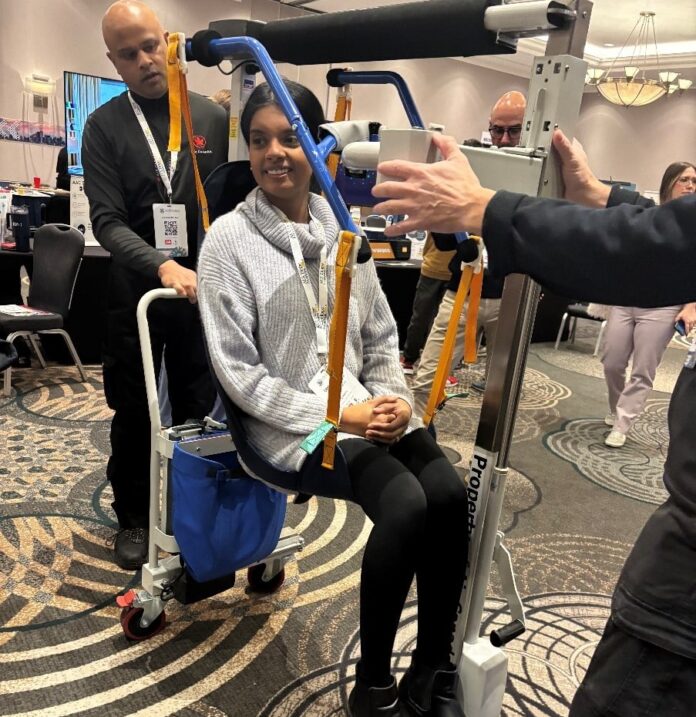

In early December, Toronto was host to the International Alliance of ALS/MND Associations Annual Meeting and the Allied Professionals Forum, bringing together health professionals, non-profit organizations, caregivers, and people living with amyotrophic lateral sclerosis (ALS) from around the world to share learnings, spark collaboration, explore practical approaches to care, and assistive technology.
Co-hosted by the ALS Society of Canada (ALS Canada) and the ALS Association, the meetings provided a unique opportunity to examine how innovations can be applied in real-world care settings to improve safety, independence, and quality of life for people affected by the disease.
The event featured a Day in the Life Suite, an interactive demonstration space where vendors showcased assistive technologies designed to support communication, mobility, safety, and daily function. More than 300 participants, including occupational therapists, speech-language pathologists, rehabilitation specialists, neurologists, caregivers, and people living with ALS, engaged with the vendors, tried devices, and explored practical applications for daily life.
Technologies highlighted included eye-gaze communication systems, smart-home supports to enhance safety and autonomy, adaptive feeding tools and mechanical assistants, virtual reality platforms adapted for low-mobility users, next-generation mobility devices, and assistive products addressing intimacy and personal relationships. Clinicians observed how these tools fit into assessment and care planning, while caregivers and people living with ALS explored features and functionality in real-life contexts.
“Allied health professionals play an essential role in ALS care,” said Kim Barry, Vice-President of Community Services at ALS Canada. “This forum created a rare opportunity for clinicians and people living with ALS to come together around assistive technology, not just to see what’s new, but to understand how and when these tools fit into real lives. Seeing technologies used in context helps professionals make more informed decisions that support independence and address daily challenges.”
The event underscored the growing role of assistive technology in ALS care and the importance of interdisciplinary approaches when introducing tools that can reduce care burden and support autonomy. Observing real-time use reinforced the value of aligning clinical decision-making with individual needs and lived experience.
Approximately 4,000 Canadians are currently living with ALS, a neuromuscular disease that progressively paralyzes people because the brain can no longer communicate with the muscles we can typically move at will. As a result, people with ALS often face a swift decline in the ability to talk, walk, eat, swallow, and eventually breathe. There is currently no cure for the disease, which carries a lifetime risk of 1 in 300 for each of us.