
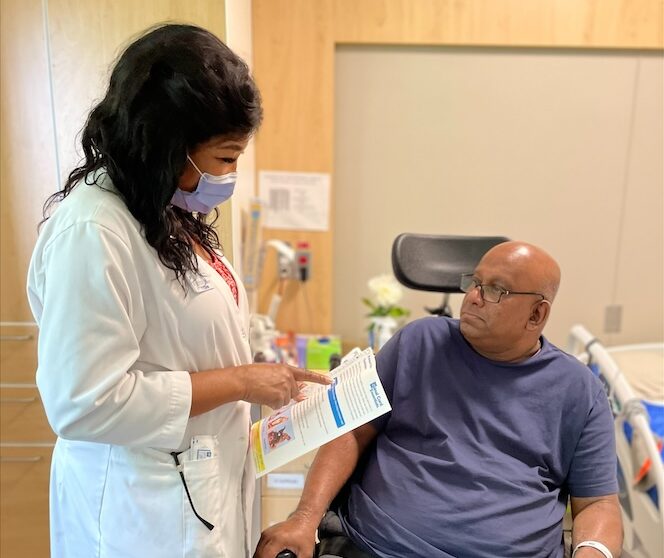

When Jay De Alwis was admitted to Toronto Rehab, Lyndhurst Centre following spinal hematoma surgery that led to paralysis from the chest down, nurses noticed something amiss with his skin health. They took immediate action.
What they discovered during their standard intake skin assessment, was Jay had stage three pressure wound injuries (PIs) on his left and right buttocks. A PI progresses in four stages, with each stage leading to deeper layers of skin cell breakdown. Each subsequent stage is also harder to recover from.
If left untreated, PIs have the potential of leading to a life-threatening condition.
PIs are caused by long periods of pressure placed on an area of the skin, which leads to a loss of blood flow and eventually cell breakdown. This is mostly seen in patients who spend extended periods of time seated in a wheelchair or laying down.
Due to his paralysis, Jay couldn’t feel the pain of his growing PIs which had been undiagnosed for weeks before he arrived at Lyndhurst Centre, where multidisciplinary teams are committed to helping patients regain as much functional independence as possible, following an SCI, before safely transitioning back into the community.
“To learn that I also had these wounds to heal from, on top of learning how to cope with my new life as a paraplegic, was difficult,” recalls Jay, who is 56 and works in the automotive industry.
“It is almost a blessing in disguise that I have no feeling, since the team told me the pain would be excruciating if I had sensation.”
Since some PIs can be prevented, it’s important for health care professionals, patients and families to be
provided proper education.
Recognizing the opportunity to fill this need, teams at Toronto Rehab have set an exceptional example of how sites across UHN can teach staff, patients and families PI prevention and treatment, and how to maintain skin health.
Empowering teams through PI education
Carol McAnuff, a clinical nurse specialist, who specializes in skin, wound, and ostomy management, is part of a cross-UHN group called the Wound Care Clinical Leadership Team, dedicated to providing wound care
education and treatment.
“It is paramount that staff have the knowledge, skills, and education to prevent these injuries, since it is UHN’s philosophy to ensure patients are being cared for to the highest
standard,” says Carol.
To that end, Toronto Rehab’s local Wound Care Clinical Leadership Team regularly presents to staff on different topics concerning pressure injury care. Last year alone, the team engaged staff in 12 “Let’s Talk Skin Health” presentations, focusing on topics such as wound management and assessment, products, new wound technologies and case reviews. The sessions had an overall turnout of more than 120 attendees.
World Pressure Injury Prevention Day is another important event that runs across TR’s sites each year in November where the interprofessional team hosts sessions on the main
concepts of PIs.
“PI prevention is a team effort,” says Carol, who explains that once colleagues receive education, they can teach it to patients, at the bedside.
Another way UHN is supporting staff in optimizing skin PI care is by leveraging Epic, UHN’s new health information system, which provides a single source of truth to TeamUHN. By offering a standardized platform to document and share information, staff are harnessing the power of technology, to help ensure no information is missed while also staying up to date on a patient’s health.
Everyone plays a role in PI prevention
The best way to prevent PIs, which can form in a matter of hours, is for a patient to switch positions as often as possible, to relieve the pressure. However, patients at the most risk of developing these injuries often can’t reposition themselves and require assistance from others.
That’s where families can play a vital role, says Joshua Moralejo, a clinical nurse specialist at Toronto Rehab, Bickle Centre, where teams care for patients experiencing one or more complex medical conditions.
“We want families to be aware that they are a part of the care, so that if a nurse is unavailable for a few hours or when the patient is discharged from the hospital, everyone will have the necessary knowledge to prevent these injuries,” says Joshua, who also specializes in wound and ostomy Care.
Patients are also involved in PI education. Wound specialists such as Carol and Joshua provide them with resources such as UHN’s Spinal Cord Essentials website, which has a dedicated section dedicated to pressure injuries. They also keep patients informed about their skin health during their assessments at the bedside.
Joshua and Carol are a part of a group of more than 20 skin and wound care experts that work across UHN to provide patients with care at all stages of their healing journey.
The Interprofessional Skin Health Steering Committee is another way that UHN has provided experts like Josh and Carol the opportunity to collaborate on clinical care, research, education, strategic leadership and decision-making around skin health with other clinical nurse specialists, physiotherapists, occupational therapists, dietitians and patient partners.
UHN is committed to continuing to find the best ways to optimize skin health for all patients by supporting experts that are leading contributors to the field.
‘Prevention is better than a cure’
To treat Jay’s pressure wounds, he was repositioned every two hours. The wounds were also redressed each day and special wound care products are applied to promote healing.
Carol, who was Jay’s wound specialist, also ensured the wounds are kept to the standard protocol approved by UHN professional practice leads, to avoid infection.
“The patient is part of this learning so that when they leave the door, we know we have set them up for a better transition back into their community,” says Carol. “Everyone, from staff to patients and their families, deserve the best education on how to prevent PIs and we are honoured to be a part of that process.”
For patients such as Jay, who has been discharged from Lyndhurst since June, explains how education to support his PI healing journey has made all the difference.
“To me, prevention is better than a cure,” Jay says. “If I knew this information from the beginning, I would’ve made the conscious effort to get myself repositioned every couple of hours.”
“This education is so valuable, and Lyndhurst did an amazing job right from the first inspection. I look forward to using this education to continue healing and getting back to my life.”