

By Victoria Alarcon
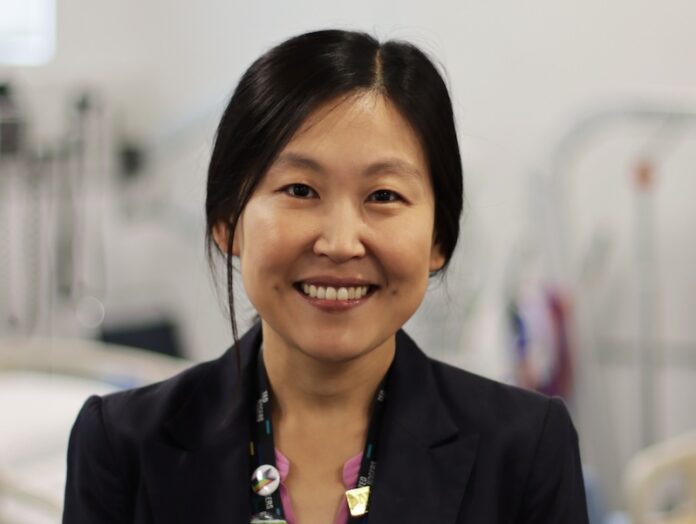
Rosanra (Rosie) Yoon’s earliest childhood memories harken back to her days accompanying her mother on the streetcar for monthly visits to Toronto’s St. Michael’s Hospital. From the age of four to eight, she was scared and nervous on these outings, but as soon as she saw her mother’s nurse, she felt safe.
“She was so good at acknowledging both of us… the way she talked to me and my mother at those monthly visits was so empathic, empowering and person-centred,” recalls Yoon. The experience piqued her interest in nursing, but it wasn’t until she learned her mother’s diagnosis that she knew mental health was her calling.
“At 13, my father handed me a discharge summary from a psychiatrist… I read through (it) and the first thing (it said) was debilitating severe schizophrenia,” says Yoon. “I remember just being in shock.
“(My father would tell me) ‘People will judge you. People will judge her. People don’t understand. So, you are never to speak of this’,” she recalls. This sparked in her a desire to be a mental health nurse.
In 1999, Yoon began studying nursing at McMaster University, where she had the opportunity to do a lot of community outreach. Every Thursday night, she and her classmates supported people who were experiencing homelessness, touring the streets of Hamilton with a backpack of socks, vitamins and gloves. “We would talk to folks and provide health teaching,” she recalls. “That shaped my whole career.”
After graduating, Yoon began working at St. Michael’s inpatient psychiatry unit. She began questioning what she was seeing in mental health. “I used to get really upset about things like restraints. I really hated putting them on people,” she says. She also didn’t like the layout of the nursing station, which was designed as a fish bowl to continuously watch people.
“I was having moral distress,” she remembers. “I didn’t know the purpose of our unit…we would admit people from emerg and discharge them in a week.” Given her concerns, Yoon’s manager encouraged her to pursue a master’s degree to see things through a bigger lens.
At the University of Toronto (U of T) in 2006, she focused her master’s on nursing with a specialty in clinical practice. She developed a passion for research and evidence.
“I was no longer relying on anecdotal or observational information, but really relying on a larger body of evidence to inform clinical practices,” she says. Yoon started seeing the trend to slowly move away from restraints and to offer different spaces for more
therapeutic engagement.
With a master’s degree in hand in 2008, she began as a clinical nurse educator at Toronto’s St. Joseph’s Health Centre mental health and addictions program. She used her knowledge to help staff see how they could improve on clinical practice through personal reflection. After two years, Yoon moved to the Centre for Addiction and Mental Health (CAMH), as an advanced practice nurse. She had a hand in the transformation of outpatient opiate treatment clinics from “strict and had restrictive environments” to a more accessible, “person-centred and interdisciplinary team approach.” She was making improvements, but began to miss her time with patients, one-on-one.
To regain that direct patient experience, Yoon went back to school to become an advanced practice NP and began working at the Jean Tweed Centre in 2013. There, she was able to help women recovering from substance use and mental health concerns. The experience was eye-opening. “The air felt different because the organization was so trauma-informed,” Yoon explains. The environment was designed to be welcoming, without cameras and extra safety policies or entry codes. “The (staff) are so attentive and everyone works in a more trauma-informed way… that intrigued me.”
Yoon was so inspired that she pursued her PhD, with a focus on organizational capability in trauma-informed practice, and specifically its effect on women’s substance use programs in Ontario.
Juggling her job as an NP and taking care of her kids, she completed her PhD over 10 years, then started a post-doctoral fellowship with U of T in 2021. This allowed her to work within the Mid-West Toronto Ontario Health Team (OHT) as a researcher for programs for people with substance use challenges. Most recently, she conducted an evaluation of a new program that shares the voices of people with lived experiences to help guide patients.
But Yoon’s journey doesn’t end there.
She is now an assistant professor at Toronto Metropolitan University (TMU). Although she never envisioned her life in academia, she says she couldn’t pass up the opportunity to develop a new mental health promotion course, which gives students “…a broad understanding of mental health, wellbeing and substance use.” It’s an area that isn’t addressed enough in undergraduate preparation, she suggests.
Yoon continues to work as an NP while balancing her program of research and teaching NP students as well as third-year nursing students.
She says she’s grateful to her mother for inspiring her. She’s also grateful to nursing for showing her there is no shame in mental health. “I really see my mother for who she is in her beautiful light,” Yoon says. And that’s why she will continue to dedicate her life to improving mental health for all.
Victoria Alarcon is communications officer/writer for the Registered Nurses’ Association of Ontario (RNAO), the professional association representing registered nurses, nurse practitioners and nursing students in Ontario. Since 1925, RNAO has advocated for healthy public policy, promoted excellence in nursing practice, increased nurses’ contribution to shaping the health-care system, and influenced decisions that affect nurses and the public they serve. For more information about RNAO, visit RNAO.ca or follow us on X (formerly Twitter), Facebook and Instagram.