
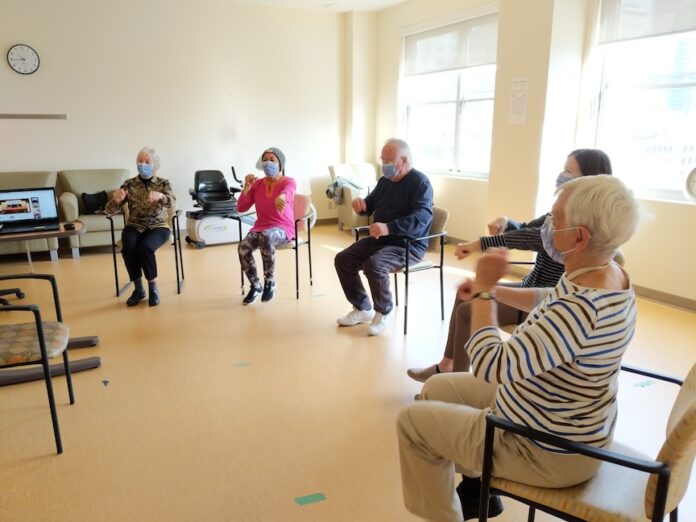

Through the Geri-Hub, wait times for patients have been reduced by up to 50 per cent for some Geri-Hub services, now achieving the lowest wait times for the services across the Greater Toronto Area.
It started as a collaborative project between UHN and Sinai Health. The goal: to provide fast, high-quality outpatient geriatric services that deliver better patient and system outcomes.
“The need for geriatric care and rehabilitation services in Canada is rapidly growing because of our aging population,” says Lindy Romanovsky, Medical Director of MSK, Geriatrics and Complex Care Rehab at Toronto Rehab. “As health care system partners, we saw it is as our duty to better integrate our services to get ahead of the curve to serve more people sooner.”
Now, after only a year of operation, this service has cut wait times in half by providing physicians with a centralized referral process that enhances patient flow across a number of outpatient and community-based services.
The service is called the Geriatric Care Hub (Geri-Hub) – a partnership that involves the coordination of UHN and Sinai Health’s geriatric outpatient and community-based services in order to connect older patients with the right care, in the right place at the right time.
“We are proud to provide a variety of specialized programming, but with so much choice, it can be challenging for referring physicians to know which services best align with their patients’ goals,” says Jennifer Mokry, Manager of Geriatric Outpatient Service Programs at Toronto Rehab.
“With a centralized hub, we’re looking at how we can best meet each patient’s individual needs across the continuum of care through a single lens to give patients the exact care they need in a more timely matter.”
A patient-oriented care model
The way this plays out is as follows: instead of a physician making a referral to a specific geriatric service, they simply fill out the hub’s common referral form outlining the reasons for referral. Once the form is completed, the experienced service coordinator at the Geri-Hub reviews the information and identifies the best specialized geriatric services to meet the patient’s needs.
The hub hosts more than seven services between the two intuitions, including programs such as Falls Prevention and the Geriatric Medicine Clinics.
Bindhu Sadasivan, service coordinator for the Geri-Hub, says this model has also helped with program optimization and flow.
“By having real-time knowledge of referral volumes, team resources and wait times, we are able to make adjustments to our services and triaging pathways to be more responsive to our patients’ needs.”
Continual improvement across care teams
For older patients, lower wait times can make all the difference in their outcomes.
“The health of an older patient can shift rapidly, so we are really aiming to provide services in the most timely manner to respond to their current concerns,” says Bindhu. “Geri-Hub services assist patients by helping to maximize their overall health and function, and by connecting them with ongoing community-based supports and services when needed.”
Through the Geri-Hub, wait times for patients have been reduced by up to 50 per cent for some Geri-Hub services, now achieving the lowest wait times for the services across the Greater Toronto Area.
Propelled forward by this significant accomplishment, the Geri-Hub team has set their sights on a new goal: reducing wait times even more and creating new connections with other organizations to better provide a continuum of care for older adult patients.
This includes Geri-Hub’s current partnership with Reconnect Community Health Services and the exploration of a partnership with The Centre for Addiction and Mental Health’s Geriatric Psychiatry Services.
“We are focused on continuous quality improvement, and the work being done through the Geri-Hub is dynamic and constantly evolving,” says Bindhu. “The Hub has been instrumental in helping us to understand the geriatric population needs of our community, which has in turn allowed us to provide better service outcomes.”