
 is an initiative that uses clinical-reality education to raise awareness.)
By Vanessa Gomez
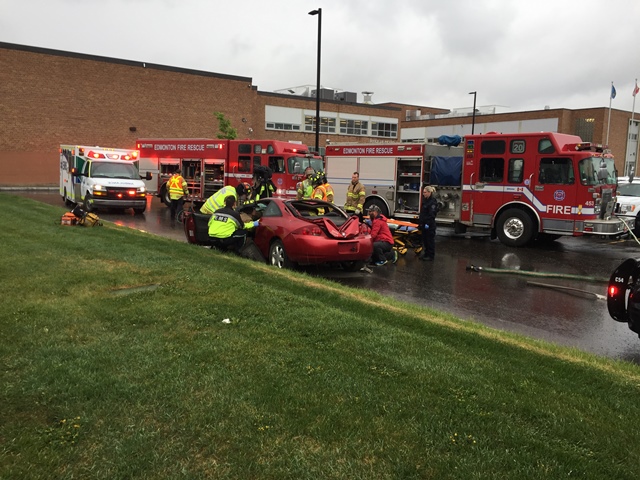
As the fallout of a simulated car crash unfolded before them under rainy skies, Grade 9 students at J.H. Picard School got an eyeful they won’t soon forget when members of Alberta Health Services Emergency Medical Services (EMS), Edmonton Police Service (EPS), Edmonton Fire Rescue Services (EFRS) and healthcare re-enacted the serious, and often fatal, consequences of impaired driving.
The P.A.R.T.Y. Program (Prevent Alcohol and Risk-related Trauma in Youth) is an initiative that uses clinical-reality education to raise awareness with youth of the preventable traumas associated with drugs, alcohol and impaired and distracted driving.
“At that age students need to understand the decisions they make have a ripple effect that goes beyond themselves,” says Alex Campbell, EMS Public Education Officer.
“Being able to see and hear the sounds of someone being cut out of a car — and seeing the number of people involved in responding to just one incident — has an impact on these students.”
Program that improves health care experience for children with ASD looking to expand
In addition to the simulated collision, EMS, EPS, EFRS, healthcare frontline staff and a spinal cord injury survivor shared stories of their experiences.
The P.A.R.T.Y. Program, now in its 25th year, offers 60 full-day sessions annually, mostly at Covenant Health’s Misericordia Community Hospital, and simulates the car collision once a year.
With injury being the leading cause of death in youth aged 15-19 in an environment of peer pressures and easy access to dangerous drugs, the P.A.R.T.Y Program plays a valuable role in their well-being.
“The primary messaging is about making smart choices. That message becomes even more important as students are increasingly faced with these new pressures,” says Marcia Lee, R.N., P.A.R.T.Y. Program Coordinator and former Emergency Department nurse. “We need to get them present to the reality of trauma.”
Currently, the program reaches about a third of Edmonton’s Grade 9 students. With the generous support of community partners — including Covenant Foundation, Edmonton Oilers Community Foundation, Edmonton Community Foundation and the Insurance Bureau of Canada — the program is in the process of expanding.
“No parent should ever face the loss of a child, particularly to something that is preventable,” says Lee. “This program moves young people and inspires them to make conscious, informed decisions.”
Vanessa Gomez works in communications at Alberta Health Services.