HomeNews & TopicsTechnology and InnovationTop ten Canadian Women Leaders in Digital Health for 2017

Top ten Canadian Women Leaders in Digital Health for 2017

Published on

New award celebrates the top 10 female visionaries who are harnessing the power of IT to transform health and healthcare in Canada today. 


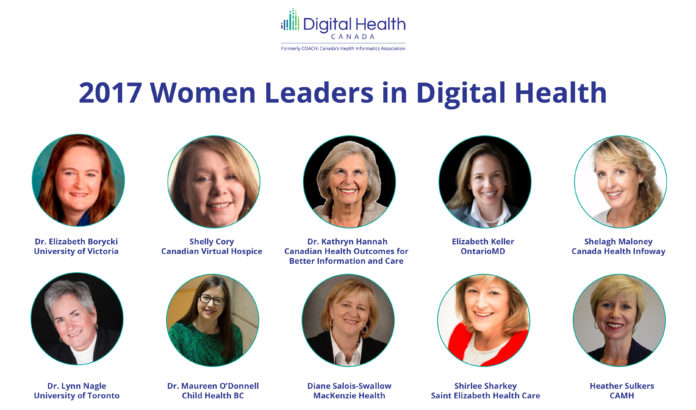
Digital Health Canada announced the winners of the inaugural Women Leaders in Digital Health Awards. The winners are:

  • Dr. Elizabeth Borycki, a tenured Professor in the School of Health Information Science and an Adjunct Professor in the School of Nursing at the University of Victoria
  • Shelly Cory, Executive Director of Canadian Virtual Hospice
  • Dr. Kathryn Hannah, Health Informatics Advisor to the Canadian Nurses Association (CNA) and Executive Project Leader of the Canadian Health Outcomes for Better Information and Care project
  • Elizabeth Keller, Vice-President Product Strategy & Delivery for OntarioMD (OMD)
  • Shelagh Maloney, Vice President, Consumer Health, Communications and Evaluation Services, Canada Health Infoway
  • Dr. Lynn Nagle, Assistant Professor at the Lawrence S. Bloomberg Faculty of Nursing and the Institute of Health Policy, Management and Evaluation at the University of Toronto
  • Dr. Maureen O’Donnell, Associate Professor, Department of Pediatrics, University of British Columbia (UBC) and Executive Director, Child Health BC
  • Diane Salois-Swallow, Chief Information Officer, MacKenzie Health
  • Shirlee Sharkey, President and CEO, Saint Elizabeth Health Care
  • Heather Sulkers, Director of Clinical Informatics, Centre for Addiction and Mental Health

The Women Leaders in Digital Health Award was created to celebrate the top ten female visionaries who are harnessing the power of IT to transform health and healthcare in Canada. The award is inclusive of all women of influence in health information technology, no matter what their specialty, and is open to all women in the digital health community in Canada.

Finalists were selected from peer-nominated submissions by the 2017 Women Leaders in Digital Health Award Adjudication Committee, consisting of Canadian health industry professionals. The selected finalists were acknowledged as having contributed to the advancement of digital health through leadership and influence in their jurisdiction or nationally; involvement with organizational change or transformation through technology; and impact on health outcomes or health system improvements.

Digital Health Canada board member Susan Anderson, Managing Director at Orion Health, led the creation of the new award. Her vision was for an award one that would celebrate leadership in two specific groups: women in digital health, and everyday leaders whose achievements go unrecognized in the industry.

In the context of the Women Leaders in Digital Health Award, leadership can be found in anyone willing to challenge themselves by stretching their personal goals. Leadership behavior, regardless of position, includes mentoring, communicating with confidence, collaborating, and striving daily to provide a positive example and create a rewarding experience for others.

“The beauty of the digital health industry is that it creates more opportunities for leadership,” says Ms. Anderson. “Not just within organizations, but across the entire digital health network. Development opportunities across the industry enable people with leadership initiative to break out of their traditional roles and participate. I think more and more organizations are encouraging employees to reach out, volunteer, connect, and engage.”

Digital Health Canada congratulates the winners of this year’s Women Leaders in Digital Health Award.

Read more about the winners here.

Read an interview with Susan Anderson here.

www.digitalhealthcanada.com


Latest articles

Still managing fax referrals manually?

Despite decades of digital transformation initiatives, one technology still dominates referral intake across hospitals...

New research links brain region to linguistic ability

The cerebellum, typically associated with movement, may also play a key role in reading...

Making Clinical Research a Care Option: How Digital Infrastructure is Expanding Access to Clinical Trials in Canada

Across Canada, there is growing recognition that clinical research should not be viewed as...

Privacy-First AI: How Federated Learning Is Transforming Canadian Cancer Research

Imagine training an AI model on patient data from hospitals in Vancouver, Toronto, and...

More like this

Still managing fax referrals manually?

Despite decades of digital transformation initiatives, one technology still dominates referral intake across hospitals...

Making Clinical Research a Care Option: How Digital Infrastructure is Expanding Access to Clinical Trials in Canada

Across Canada, there is growing recognition that clinical research should not be viewed as...

Privacy-First AI: How Federated Learning Is Transforming Canadian Cancer Research

Imagine training an AI model on patient data from hospitals in Vancouver, Toronto, and...

How AI could help or hinder Canada’s health care system

HN Summary • AI could help address Canada’s healthcare staffing crisis by improving efficiency, triage,...

Patient care runs on mobile devices. Is your fleet holding you back?

Dead batteries. Lost devices. Outdated software. Rising security threats.  These are all mobility threats that...

Keeping EDs Open & Reducing Wait Times

Strategic solutions to support emergency departments under strain. Emergency Departments (EDs) are the essential safety...