


By Alyssa Alibaksh
As one of the hardest hit communities for COVID-19 in the province, William Osler Health System (Osler) is making the most of its technology expertise to continue delivering safe, compassionate health care. An online Emergency Department (ED) pre-registration form, ED Wait Clocks, and a Digital Patient Engagement platform have all been instrumental in further enhancing the patient experience during one of the most challenging periods in Osler’s history.
 ED online pre-registration form supports timely access to care
Osler’s new Online Pre-Registration Form means shorter wait times for patients to see a physician by minimizing the time needed to register for emergency care at both Osler’s Brampton Civic Hospital and Etobicoke General Hospital. The pre-registration form option is available to all ED walk-in patients at the time of their visit via a QR code displayed throughout both EDs.
The online tool gives patients greater autonomy to fill out their confidential information electronically on their personal devices, eliminating the need to verbally share personal information in a public setting. Registration Clerks are available to help patients who require help with the online tool.
“Osler’s EDs continue to be among the busiest in the province,” said Kiki Ferrari, Osler’s Chief Operating Officer. “Implementing the Online Pre-Registration Form has allowed us to streamline and enhance the patient experience by improving the accuracy of collected patient information and the time to see a physician. This is ultimately supporting more efficient patient flow, ensuring Osler can continue to care for its community when and where needed.”
ED wait clocks help inform decision-making
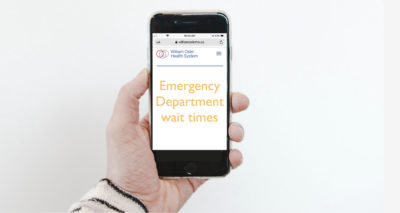
Available on its website and in each site’s ED waiting rooms, Osler’s electronic ED Wait Clocks are helping patients to plan ahead, and make informed decisions about their care. The ED Wait Clocks let patients know how many patients are being treated, how many are waiting to be treated, and what the predicted wait time is over a 24-hour period in each ED. Wait times reflect the 90th percentile – meaning nine out of 10 patients are likely seen within this estimated time.
“One of the most frequent questions patients in our EDs ask is ‘How much longer will it take for me to see a doctor?’ and the ED Wait Clocks are another way to help keep people informed during what can be a very stressful time,” said Dr. Andrew Healey, Osler’s Chief of Emergency Medicine.
 Digital patient engagement technology supports surgical patients
Another piece of technology having a positive impact on the patient experience is Osler’s Digital Patient Engagement platform. Launched in August 2021, the platform is helping improve safety, quality and health care outcomes for surgical patients. The patient engagement platform guides patients before and after their surgical procedures with education, progress tracking and symptom monitoring accessed via their personal devices (i.e. smartphone, tablet, or computer).
The platform offers customized dashboards that enable the Osler care team to monitor patient health throughout their journey. The platform enhances accessibility by supporting multiple languages that are prominent in Osler’s diverse communities including English, Punjabi, Urdu, Hindi, Portuguese, Italian and French.
As of September 2021, more than 3,400 patients have already benefited from the digital experience. One patient shared, “I felt less on my own after leaving the hospital.” Another patient shared that the digital experience was, “quick and easy and felt like someone was checking in on me each day.”
Building on these successes, Osler is continuing to innovate and advance new technologies like the online pre-registration form, ED Wait Clocks, and Digital Patient Engagement platform to further inspire patient confidence, improve access to care, and support positive patient outcomes.
Alyssa Alibaksh works in the Strategic Communications department at William Osler Health System.