
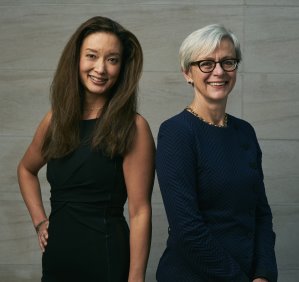

As Interim Radiologist-in-Chief for the Joint Department of Medical Imaging (JDMI), Dr. Heidi Schmidt is accustomed to the informal consultations that take place daily between colleagues. And she’s equally aware that family doctors don’t have the same kind of access to that expertise.
“They’re lacking the hallway conversations that happen in the hospital,” says Dr. Schmidt, “where you can ask someone, ‘Hey, by the way, what do you think I should do here?’”
Catherine Wang, VP of Clinical Operations and Diagnostic Partnerships at the University Health Network (UHN), and administrative lead for JDMI, which encompasses medical imaging across UHN, Women’s College Hospital and Sinai Health System, elaborates. “Tertiary and quaternary care hospitals are built for the specialist world. But if you think about it, patients seldom, if ever, see a specialist. They mostly go to their family doctor. So it’s not good enough that we’re only understanding what the specialist needs.”
Once they’d identified an opportunity to do better, Catherine and her team went to work.
“The radiologist isn’t the first person who springs to mind when you’re thinking of specialists,” she says. “But the radiologist is incredibly important to ensure an accurate diagnosis and determine appropriate treatment options. We have a huge role to play in changing the system if we really want to improve access for all patients in the community and hospitals.”
To start, they asked themselves some basic questions: How can we create a better relationship between the radiologist and the family doctor? How can we help primary-care physicians order the most appropriate test and schedule it in the appropriate timeframe? How might we streamline the system so that patients don’t unnecessarily turn to Emergency departments (ED) due to limited imaging access in the community?
The answers became an innovative JDMI call centre program to give family doctors point-of-care radiology advice and faster access to imaging services for their patients.
Dr. Schmidt, who along with JDMI’s Office of Strategy Management and Operational leaders, founded the program, says, “In many cases the ED is the only way a family physician can access urgent imaging. By offering a direct pathway to our diagnostic services and radiologist consultation, a significant number of imaging related ED visits can be avoided.”
Additionally, with JDMI’s guidance, an initial request for magnetic resonance imaging (MRI) might be updated to a more appropriate and more readily available computed tomography (CT) scan, giving family physicians and their patients quicker access to the right test, and helping reduce wait times for other imaging studies in high demand.
And the benefits extend beyond this initial consultation, says Catherine. “We can design a report to meet the needs of the primary care physician, a report that’s not the same as the one that gets sent to a cardiologist, for example. We can also play a navigator role. Rather than simply sending the report and leaving it for the family doctor to figure out, we can aid in the interpretation of the report and suggest the next course of action, all because we now have a relationship with the doctor that we didn’t have before.”
Plans are underway to make the program even more useful and accessible. “If we can figure out a provincial strategy to allow electronic referrals, then we can really get going,” Catherine explains. “Right now, it’s all done manually, which is cumbersome. With an electronic platform, every family physician can have access to the right specialist, including radiology. We can also build in clinical decision support, like data related to referral practices. We can say to a family physician, ‘here’s your order in practice, and here’s what your order looks like in the context of all your peers ordering the same test. Are you an outlier? Are you not?’ We can offer real-time feedback and meaningful support.”
The call centre program is now built into a cross-organization, quality improvement collaborative, branded as SCOPE (Seamless Care Optimizing the Patient Experience) and the team at JDMI has provided guidance to other Toronto health providers to implement their own call centres following the same model.
This emphasis on primary care is mirrored in provincial policy, and to Catherine, that policy makes perfect sense. “The family doctor is the gatekeeper to the whole system. The lifetime health of most patients is probably managed by a family doctor. Specialist may come and go, but the primary care physician is going to be with that patient for the duration.”
“Some family doctors know exactly what they want to do, and we want to be respectful of that,” she adds. “But, innovations pioneered here at JDMI have led to real, tangible improvements in support for primary care practitioners. Going forward, we can play an even greater navigation role, and try to do away with the Snakes and Ladders game that patients sometimes go through.”