HomeNews & TopicsSurgeryCanada’s first upper limb transplant performed at UHN

Canada’s first upper limb transplant performed at UHN

Published on

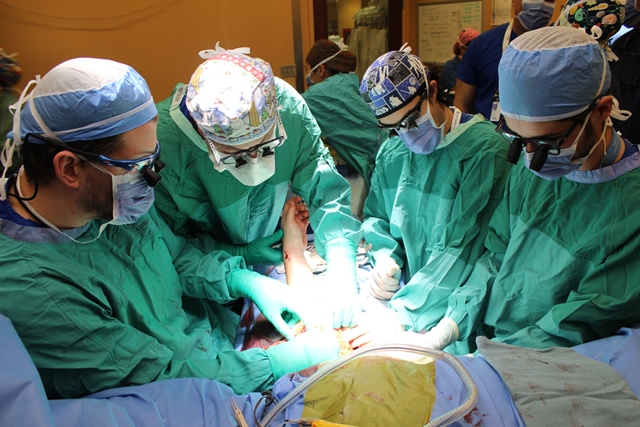
Dr. Steven McCabe of Toronto Western Hospital leads multi-disciplinary team in 14-hour procedure involving 18 surgeons.

Dr. Steven McCabe was part of the surgical team that performed the world’s first hand transplant in 1999 in Louisville, Kentucky.

Fast forward 17 years and Dr. McCabe has made the possibility of hand transplants in Canada a reality, leading a multi-disciplinary team of experts to complete the country’s first transplant of the upper limb.

The team at Toronto Western Hospital (TWH) successfully attached the hand and forearm from a donor to a patient who had lost her arm below the elbow in an accident several years ago.

“We are very proud to have successfully performed this forearm and hand transplant procedure,” said Dr. McCabe, Director of TWH’s Hand and Upper Extremity Transplant Program.

“This is a tremendous accomplishment involving many people across several programs, and we are excited to make this treatment possible and available for patients who would benefit from it.”

The procedure lasted approximately 14 hours and involved 18 surgeons of a variety of different surgical disciplines from a number of hospitals.

To protect the privacy and confidentiality of the patient, the donor and their families, the hospital will not be releasing the date of the surgery or any possible identifying details.

“It’s another milestone for our program,” says Dr. Atul Humar, Director of The University Health Network’s (UHN) Multi-Organ Transplant Program. “With this Canadian first, we are entering another era in transplantation.

“This kind of effort requires not only the expertise of a diverse surgical, medical, and rehabilitation team at UHN, but also a life-changing gift by a tissue and organ donor and his or her family.”

UHN has Canada’s largest organ transplant program, performing more than 500 transplants every year, and providing world-class follow-up care to over 5,000 recipients.

A wide range of experts are required to successfully complete the pre-transplant, transplant and post-transplant phases. This procedure was made possible by the knowledge of immune suppression and the prevention of rejection in UHN’s MOT Program, Toronto Western Hospital’s Hand and Upper Extremity Transplant Program, the Arthritis Program and the Trillium Gift of Life Network (TGLN) that oversees the organ donation process.

Since Dr. McCabe was part of the pioneering surgery in 1999, more than 110 hand transplants have taken place in more than a dozen countries.

Latest articles

New approach opens door to better-targeted treatments and faster drug discovery for complex diseases

McGill researchers have developed an AI tool called SIDISH that identifies high-risk cancer cells driving aggressive disease, enabling more precise and targeted treatment strategies. By linking single-cell data with patient outcomes, the tool can predict disease progression and simulate responses to potential drug targets, helping accelerate drug discovery and repurposing. While still in development, SIDISH shows promise for advancing personalized cancer care and improving outcomes across multiple tumour types.

Canadian Cancer Society urges lowering colorectal cancer screening age to 45

The Canadian Cancer Society is urging provinces to lower the colorectal cancer screening age from 50 to 45, citing rising rates among younger adults and evidence that earlier screening could prevent over 15,000 cases and 6,100 deaths. Younger patients are more often diagnosed at advanced stages, making early detection critical. Expanding access to simple screening tools like FIT tests could significantly improve outcomes and save lives.

Unleashing natural killer cells against cancer

Researchers at McGill University have developed a new strategy to enhance natural killer (NK) cells, enabling them to better penetrate tumour defenses and destroy cancer cells. Using small-molecule drugs to temporarily boost NK cell activity—rather than permanent genetic modification—the approach showed strong results against multiple hard-to-treat cancers in preclinical studies. The scalable, ready-to-use therapy could make immunotherapy faster, safer, and more accessible, with future clinical trials planned for aggressive cancers like acute myeloid leukemia.

Doctors report false health information, lack of health data sharing put patient care at risk

A new CMA survey reveals major risks to patient care in Canada, with 99% of physicians reporting that disconnected health systems limit access to critical patient information and nearly half witnessing serious adverse outcomes as a result. At the same time, 97% of doctors say they have intervened to address harm caused by false or misleading online health information, including AI-generated advice. The findings highlight the urgent need for integrated digital health systems and stronger efforts to promote reliable health information.

More like this

Martha Tripicio – Nursing Hero

Humber River Health t is with profound respect and admiration that I nominate Martha Tripicio...

Catherine Bergman – Nursing Hero

University Health Network Catherine Bergman is recognized at Toronto General Hospital for her clinical expertise,...

Iryna Fedoryak – Nursing Hero

Sunnybrook Health Sciences Centre (St. John’s Rehab) We are honoured to nominate Iryna Fedoryak for...

Domino Puson – Nursing Hero

Trillium Health Partners We are honoured to nominate Domino Puson for the 21st Annual Hospital...

Susan Davidson 3rd Place Nursing Hero

Unity Health (St. Joseph’s Health Centre) am honored to nominate Susan Davidson for the Nursing...

Rodolfo D. Lastimosa Jr. 2nd Place Nursing Hero

Southbridge Care Homes am honored to nominate Rodolfo D. Lastimosa Jr. for the Nursing Hero...