

By Robyn Cox
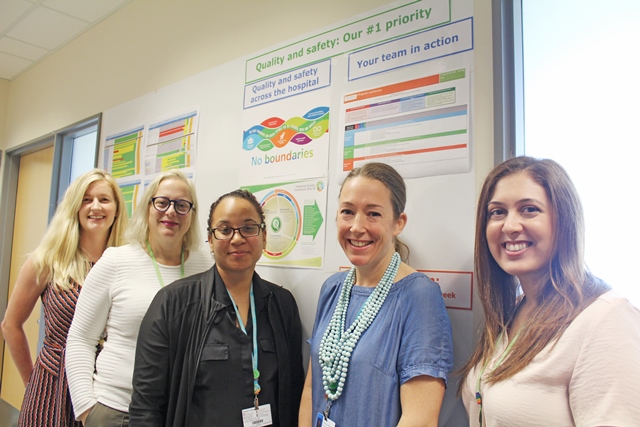
When Adrienne Zarem and Alifa Khan, family leaders at Holland Bloorview Kids Rehabilitation Hospital, first joined the Family Leader Accreditation Group (FLAG) as chair and vice-chair they knew they were joining something different. They were on the leading edge of a movement to advance health quality through shared decision-making with patient and families. FLAG posed an opportunity for family leaders to improve quality and safety as a crucial part of Holland Bloorview’s accreditation preparedness strategy.
One year later and they are two of the first family surveyors with Accreditation Canada, an organization that reviews health centres across Canada for best practices in quality and safety. They are bringing lived experience and valuable insight to the accreditation process, nationwide.
How did Zarem and Khan go from shifting the conversation at one hospital to shifting the conversation across the country in a single year?
Before taking leadership roles on FLAG, Zarem and Khan were members of the Family Advisory Committee at Holland Bloorview. They were accustomed to informing and developing initiatives across the hospital. Zarem was also participating in a Canadian Association of Pediatric Health Centres (CAPHC) committee working on a reporting system for pediatric rehabilitation centres across Canada.
In April 2016 the quality, safety and performance team at Holland Bloorview launched an unprecedented engagement strategy to embed family leaders on its accreditation steering committee and on each accreditation working group at the hospital, to prepare for the hospital’s accreditation survey in October 2017. At the same time, they developed the FLAG framework to bring these family leaders together to share experiences and learnings. It was a natural fit for Zarem and Khan to take leadership roles.
“Patients and families know best what will improve their care experience most,” says Sonia Pagura, senior director of quality, safety and performance at Holland Bloorview. “Health care organizations must partner equally with patients and families through training and engagement on quality and safety so improvements make sense from a patient and family perspective.”
Laying groundwork for meaningful participation through the development of the FLAG framework was the first step. Making sure everyone felt confident taking part in quality improvement conversations was the next. Holland Bloorview provided toolkits and training to staff and family leaders on how to partner effectively.
“The quality, safety and performance team invested time and resources to teach Holland Bloorview staff the necessary skills to partner meaningfully,” says Zarem. “They also trained family leaders in the science of patient safety and quality improvement so discussions were fulsome, and partnerships were genuine.”
Realizing they could help other organizations partner more effectively with patients and families, Khan and Holland Bloorview’s quality team leads worked with the Canadian Patient Safety Institute and master facilitators to update Patient Safety Education Program (PSEP-Canada) modules in May 2016. The updated modules reflect the patient and family perspective and support health sector staff, patients and families in advancing patient safety together.
“Leveraging the knowledge and lived experiences of health system users is paramount,” says Khan. “Taking our knowledge and experience beyond the walls of single organizations enables providers, patients and policy makers to improve care and makes a meaningful impact on outcomes for everyone.”
As Zarem and Khan grew their expertise, more organizations reached out with opportunities to promote health quality across the country. This summer Accreditation Canada asked Zarem to train as a family surveyor. While Holland Bloorview was having its accreditation survey in October, Zarem was in Halifax doing her first survey at Nova Scotia Health Authority.
Zarem was also recently asked to co-chair the Assessment Methodologies technical committee at Health Standards Organization (HSO). HSO is a national body that develops the standards and measures used by Accreditation Canada. Zarem will be using her experience with FLAG and as a patient surveyor to shape decision-making, system wide.
This fall Khan completed her training to become a family surveyor with Accreditation Canada, also bringing her lived experience and knowledge to health systems throughout the country. Additionally, she recently joined the Primary Health Care technical committee at HSO.
While Zarem and Khan are advancing patient and family centred quality and safety across Canada, they continue to strengthen quality and safety practices at Holland Bloorview. Their significant contributions, and the contributions of all FLAG members, in the many months leading to the hospital’s on-site survey in October helped Holland Bloorview meet 100 per cent of the standards, securing Accreditation with Exemplary Standing for the second time in a row.
Looking forward, Zarem and Khan are excited to build on this momentum. “I am infinitely confident that Holland Bloorview’s team of family leaders will continue to partner and find innovative ways to drive client centred quality and safety, both within the hospital and beyond,” says Zarem.
Robyn Cox is a Communications Coordinator at Holland Bloorview Kids Rehabilitation Hospital.