Help for caregivers

Published on

Leo Diagnault has plenty of stories to tell. As a younger man, the World War II veteran worked all across the country—on the CN rail lines, as a security guard at Rideau Hall, and as an airline mechanic. Today, Leo spends most of his time at home, in an apartment he shares with his wife and caregiver, Esther. “My husband is very friendly,” says Esther. “He can remember lots of things about those experiences. He loves to share his stories when he can remember.”

Leo started showing signs of dementia five years ago and Esther soon became his full-time caregiver. It’s a role she performs lovingly, but it can be exhausting. “I take care of him every day, 24 hours a day. He uses a walker around the house and sometimes he’s off balance, so I keep an eye on him. If he gets up in the night, I get up with him.”

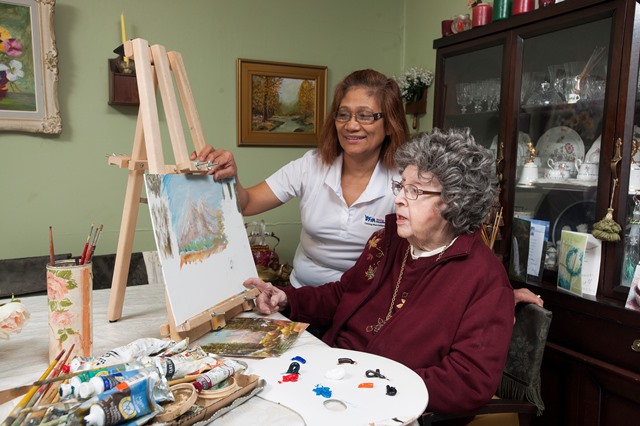
Esther knew she could use extra support so she could take a break, but she wanted to feel good about the type of care Leo received from an outside caregiver. Through Veterans Affairs, the couple learned about VHA Home HealthCare’s free Activation Program. In this one-year pilot program, VHA’s trained Personal Support Workers or volunteers do stimulating activities with the client while their caregiver has time to his or herself. Clients receive a three-hour visit twice a week for three months.

In a focus group survey, caregivers indicated that they wanted more activity for their loved one. For Esther, this meant someone who would listen to and chat with her conversational husband. Her VHA volunteer worker “is very creative. Sometimes I don’t go out right away and I see he starts working with Leo immediately, using puzzles and games to make his brain work. He does it in a way that my husband can follow along,” she explains.

That is exactly how this free program is designed to work. “We do an in-home assessment to get to know the client, their past, their interests and limitations,” says Elise. “Then we create a customized care plan for them. A lot of clients have cognitive, memory and dementia issues, so we do games with them, get them chatting and looking at pictures, as well as physical activity such as bedside deep breathing, seated exercises, and just getting out and taking walks. It’s very specific to the client.”

With the free time she has gained, Esther can get groceries, make appointments or simply go to the mall. “It is very helpful for me—just to be outside and relax—and I don’t feel worried about my husband.” The sessions also help Leo. “He really enjoys when the worker comes, and he remembers a lot during their sessions. He cannot remember when he is gone, but while he is there he enjoys it very much, and he recognizes him when he sees him again.”

The pilot program will wrap up at the end of the year, but VHA Home HealthCare is hoping more funding will be available to make full implementation possible so more clients can benefit from activation and their caregivers can have peace of mind.

Activation Tips:

  • Try various activities including verbal, visual and hands-on activities. Be aware of your loved one’s limitations.
  • Read together or do simple puzzles.
  • Play music the person is familiar with to tap into deep memories
  • Do arts and crafts such as flower arranging, painting with water colours or modelling with clay.
  • Try gentle physical activity like seated stretches or short walks.
  • Always reassure your loved one that they are doing a good job.


Latest articles

New approach opens door to better-targeted treatments and faster drug discovery for complex diseases

McGill researchers have developed an AI tool called SIDISH that identifies high-risk cancer cells driving aggressive disease, enabling more precise and targeted treatment strategies. By linking single-cell data with patient outcomes, the tool can predict disease progression and simulate responses to potential drug targets, helping accelerate drug discovery and repurposing. While still in development, SIDISH shows promise for advancing personalized cancer care and improving outcomes across multiple tumour types.

Canadian Cancer Society urges lowering colorectal cancer screening age to 45

The Canadian Cancer Society is urging provinces to lower the colorectal cancer screening age from 50 to 45, citing rising rates among younger adults and evidence that earlier screening could prevent over 15,000 cases and 6,100 deaths. Younger patients are more often diagnosed at advanced stages, making early detection critical. Expanding access to simple screening tools like FIT tests could significantly improve outcomes and save lives.

Unleashing natural killer cells against cancer

Researchers at McGill University have developed a new strategy to enhance natural killer (NK) cells, enabling them to better penetrate tumour defenses and destroy cancer cells. Using small-molecule drugs to temporarily boost NK cell activity—rather than permanent genetic modification—the approach showed strong results against multiple hard-to-treat cancers in preclinical studies. The scalable, ready-to-use therapy could make immunotherapy faster, safer, and more accessible, with future clinical trials planned for aggressive cancers like acute myeloid leukemia.

Doctors report false health information, lack of health data sharing put patient care at risk

A new CMA survey reveals major risks to patient care in Canada, with 99% of physicians reporting that disconnected health systems limit access to critical patient information and nearly half witnessing serious adverse outcomes as a result. At the same time, 97% of doctors say they have intervened to address harm caused by false or misleading online health information, including AI-generated advice. The findings highlight the urgent need for integrated digital health systems and stronger efforts to promote reliable health information.

More like this

Canada’s Hospitals Can’t Solve the Seniors Care Crisis Alone

Across Canada, hospitals are under enormous pressure, with lengthy wait times and beds filled...

Small Care Homes to support aging population

HN Summary • Vancouver Coastal Health is launching Small Care Homes, a home-like long-term care...

Hospital to Home program aims to reduce ER visits

HN Summary • Windsor Regional Hospital, in partnership with SE Health, has launched the Hospital...

Compassionate Care for Older Adults with Dementia

HN Summary • Baycrest’s interdisciplinary, resident-centred approach addresses the behavioural symptoms of dementia by identifying...

Slower-walking seniors at risk for falls benefit most from home-based exercise program

HN Summary • New research shows a home-based strength and balance exercise program can significantly...

Are we entering a new era of dementia treatment?

A Q&A with Sunnybrook Neurologists Over the next five years, researchers estimate that more than...