

Rebekah Churchyard’s grandfather was diagnosed with dementia at age 63. A former Christmas tree farmer, he found himself with little to do and increasingly confused in his environment. He’d sit on the stoop of his home, refusing to go to a day program designed for people living with dementia. His granddaughter vowed to find better options for Canadians with dementia, and for their caregivers.
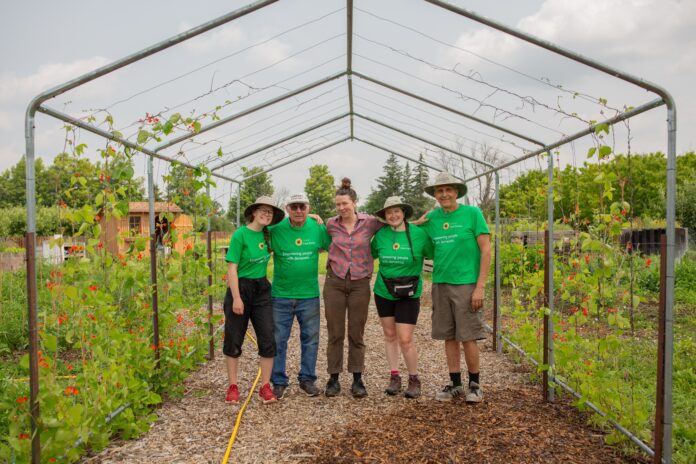
In 2022, Churchyard opened Green Care Farms in Milton, Ontario – the first of its kind in Canada – a half-acre sensory garden with programming created for people living with dementia. Set amid the 165-acre Andrews Farm Market & Winery, it was the culmination of her education, including a Master of Social Work in Gerontology, work experience (providing specialized geriatric services at home and community care support services), and travelling down a long road to make her dream project a reality.
Green Care Farms couples a therapeutic supportive setting with agricultural activities. “We have two aims,” says Churchyard, CEO and founder. “One, to provide a meaningful and fun engagement for the person with dementia. It’s their community, their space, their garden. It gives them a sense of community and purpose. So many people have lost those parts of their identity. And two, to provide respite to caregivers.”
The latter hits close to home. Churchyard saw how much her grandma struggled to take care of her grandpa. “She ran herself ragged and couldn’t get the support she needed,” recalls Churchyard.
Her grandfather was also struggling. After moving to a long-term care home, he was on a locked unit and unable to go outside, where he had spent so much of his life farming. He was unoccupied and spent most of his day in bed. He passed away at age 77.
Green Care Farms was created to meet the needs of people like Churchyard’s grandparents. Caregivers can enroll loved ones in a summer-long, supervised program, where they can do chores – planting, watering and harvesting produce. “Many people from various backgrounds thrive in this program,” she explains. “I love seeing them making jokes, brainstorming ideas and making plans to bring seeds and garden tools on their next visit.”
While there are care farms worldwide, they’re relatively new to Canada. When Churchyard heard about them at a conference, her journey to create one for those with dementia began. She spent five years with the Toronto Council on Aging, learning how charities work, how to develop programs, access grant funding and, most importantly, what older Canadians needed. Later, when she had a chance to lease some land for her sensory garden, she leapt at the opportunity.
She credits AGE-WELL training and programs for helping her hone her concept and being able to pitch it effectively by focusing on the need it fulfilled and having the research to back it up. From day one, researcher Dr. Arlene Astell, Churchyard’s mentor at AGE-WELL, believed in Green Care Farms and the vision behind it.
“Having exposure to mentors and to people who are interested in your ideas and in helping you flesh out and strengthen your ideas was extraordinarily valuable to me,” says Churchyard. “I wouldn’t have been able to create Green Care Farms without that support.”
By Michele Sponagle
Michele Sponagle is a freelance journalist and editor. AGE-WELL is a federally-funded Network of Centres of Excellence. AGE-WELL brings together researchers, older adults, caregivers, partner organizations and future leaders to accelerate the delivery of technology-based solutions for healthy aging. www.agewell-nce.ca