HomeNews & TopicsPatient CareMy experience working with Doctors Without Borders/Médecins Sans Frontières (MSF)

My experience working with Doctors Without Borders/Médecins Sans Frontières (MSF)

Published on

By Evelyn Cote Grenier

Physiotherapy is a passionate, giving profession that enables me to support people and often reach communities that do not have great access to care. In recent years, my path has led me to humanitarian work and I have made it to… Baghdad.

After several months of waiting, in November 2018, I received an offer to work for six months as a Physiotherapy Activity Manager (PAM) in a Doctors Without Borders / Médecins Sans Frontières (MSF) rehabilitation centre in Baghdad! Departing in January! Wow! A sudden mix of excitement and anxiety briefly took hold of me… but I made my decision quickly—I would leave in January for Iraq.

What do you know about Iraq? What images do you have in your mind? You might be surprised… Certain regions of Iraq are much more modern than I had thought.

How do you prepare for such an experience?

Read and breathe.

How do you get through such an experience?

Breathe a lot.

Under the blazing sun, I am likely going through one of the most demanding experiences in terms of acclimating to an environment that sometimes lacks softness, and adapting to my new professional duties, my multicultural team and the pace that always takes us further. I regularly question myself . Am I useful? Are we useful? The answer is yes. I am convinced of the positive impact that our presence has on each person and family that comes to the rehabilitation centre, but also on the national health care system.

The centre was put into place by MSF after years of violence. Without it, many Iraqis unfortunately would not have access to sufficient and essential rehabilitation services, and the nation would be deprived of the contribution of hundreds of people. Without it, many patients would not be able to fulfil their roles in their family or return to school or to work. A great deal of them would be stuck in bed. The centre also looks after the mental health of its patients, many of whom still carry the scars of various wars. Concretely, the centre’s capacity at that time was 20 hospitalized patients and around 120 outpatients. All the patients have suffered fractures, which are often nasty, and/or amputation, with a low rate of nerve damage, and would receive support at various stages of their rehabilitation.

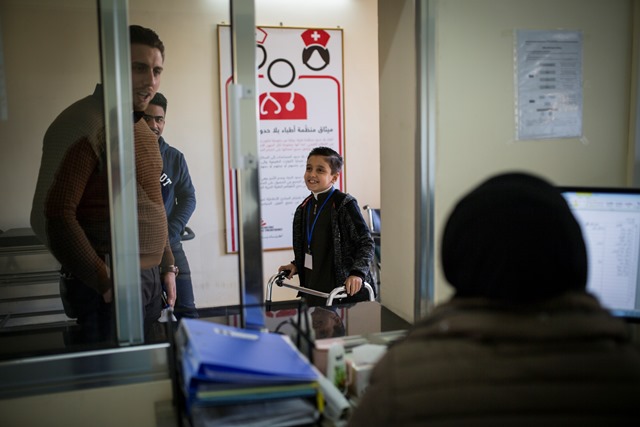
I see resilience every day. One such story involves a patient I met one Thursday morning during our weekly medical rounds. This young man had been in a terrible accident on the family farm when he was just a child, leaving him with only one arm and one leg. For more than 10 years, he mainly got around by dragging himself along the ground, and thereby developed incredible physical and mental strength. This young man came out of his rehabilitation with MSF upright and proud, walking toward a brighter future. Despite years of violence and a persistently tense climate, the people look or try to look forward. Nothing comes easy in the cradle of humankind.

The MSF project also supports the national health care system, primarily through knowledge sharing. Unfortunately, the health care and education systems have been particularly hard hit by war, which has taken a toll on the quality of physiotherapy in Iraq. Today’s system is still marked by the past and by rampant corruption—it struggles to recover and regain its former prestige. The project has given us the chance to improve physiotherapy training so that more people can receive rehabilitative care. As a PAM, my overall role is to support better physiotherapy practices and to work in cooperation with Iraqis to develop services specifically for people who have suffered orthopaedic trauma.

Although Baghdad is fairly modern and freer than its neighbours, tight security checks have become a regular part of day-to-day life. Religion is also very present and serves as an anchor to soothe discouragement or passing frustrations.

Living in Baghdad means living with a heavy past and under the shadow of radicalism… It also means hope. Hope that Iraq’s culture, which is rich, celebratory, generous and ancient, will be recognized and make people forget about violence.

Evelyn Cote Grenier  is a physiotherapist from Saskatchewan.


Latest articles

New approach opens door to better-targeted treatments and faster drug discovery for complex diseases

McGill researchers have developed an AI tool called SIDISH that identifies high-risk cancer cells driving aggressive disease, enabling more precise and targeted treatment strategies. By linking single-cell data with patient outcomes, the tool can predict disease progression and simulate responses to potential drug targets, helping accelerate drug discovery and repurposing. While still in development, SIDISH shows promise for advancing personalized cancer care and improving outcomes across multiple tumour types.

Canadian Cancer Society urges lowering colorectal cancer screening age to 45

The Canadian Cancer Society is urging provinces to lower the colorectal cancer screening age from 50 to 45, citing rising rates among younger adults and evidence that earlier screening could prevent over 15,000 cases and 6,100 deaths. Younger patients are more often diagnosed at advanced stages, making early detection critical. Expanding access to simple screening tools like FIT tests could significantly improve outcomes and save lives.

Unleashing natural killer cells against cancer

Researchers at McGill University have developed a new strategy to enhance natural killer (NK) cells, enabling them to better penetrate tumour defenses and destroy cancer cells. Using small-molecule drugs to temporarily boost NK cell activity—rather than permanent genetic modification—the approach showed strong results against multiple hard-to-treat cancers in preclinical studies. The scalable, ready-to-use therapy could make immunotherapy faster, safer, and more accessible, with future clinical trials planned for aggressive cancers like acute myeloid leukemia.

Doctors report false health information, lack of health data sharing put patient care at risk

A new CMA survey reveals major risks to patient care in Canada, with 99% of physicians reporting that disconnected health systems limit access to critical patient information and nearly half witnessing serious adverse outcomes as a result. At the same time, 97% of doctors say they have intervened to address harm caused by false or misleading online health information, including AI-generated advice. The findings highlight the urgent need for integrated digital health systems and stronger efforts to promote reliable health information.

More like this

Doctors report false health information, lack of health data sharing put patient care at risk

A new CMA survey reveals major risks to patient care in Canada, with 99% of physicians reporting that disconnected health systems limit access to critical patient information and nearly half witnessing serious adverse outcomes as a result. At the same time, 97% of doctors say they have intervened to address harm caused by false or misleading online health information, including AI-generated advice. The findings highlight the urgent need for integrated digital health systems and stronger efforts to promote reliable health information.

From Compassion to Impact: SHN Coordinator Honoured for Advancing Organ Donation

HN Summary • Sandra Ricketts-Fusca, a Patient Care Coordinator at Scarborough Health Network, has been...

Designing the future of care: Advancing an AI-enabled hospital system

HN Summary • William Osler Health System is embedding AI into its new Epic hospital...

How AI is transforming patient care in Canada—before the first visit

HN Summary • New study reveals most Canadians don’t turn to AI for mental health...

Improving Patient Experience Starts with How Teams Communicate

Healthcare teams are being asked to do more with less. Staffing shortages, rising patient...

Making Clinical Research a Care Option: How Digital Infrastructure is Expanding Access to Clinical Trials in Canada

Across Canada, there is growing recognition that clinical research should not be viewed as...