

By Shelly Willsey
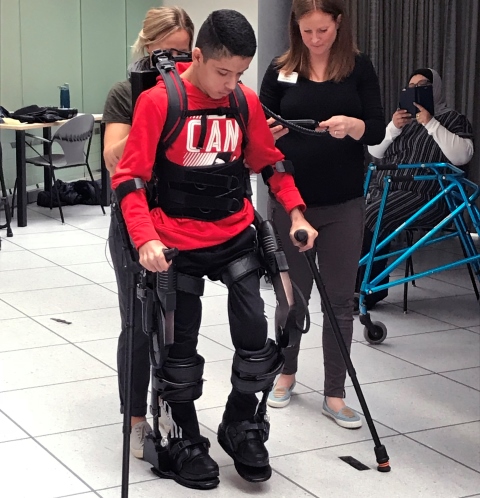
When Hussain Alhussainy puts on a high-tech exoskeleton during therapy, he feels like Iron Man.
Earlier this year, the 16-year old became one of Glenrose Rehabilitation Hospital’s first pediatric patients to use the Ekso GT exoskeleton as part of his therapy for cerebral palsy.
The Glenrose is finding new ways to use this wearable robot that lets a person with lower extremity weakness stand up and walk. The Ekso was first introduced to Glenrose adult patients in 2015, but new features have since led to new therapies for adult patients as well as the opportunity to help pediatric patients.
“Not only does it allow me to walk, but it helps with my posture and guides me on how to walk,” says the Edmonton teen. “It makes you put in the work for your therapy, and if you can’t, it assists you. It makes me feel powerful.”
The Ekso measures the wearer’s shifts in balance, weight and posture, and motors in the suit’s knees and hips auto-adjust to deliver the right amount of power that’s needed to walk.
The technology even offers new features that now allow therapists to isolate a specific leg, lessen the amount of assistance the suit provides or increase the resistance.
“As our Glenrose team becomes further trained with the Ekso and the programming advances, we’re able to expand the kinds of patients we’re helping,” says Vickie Buttar, the hospital’s Rehabilitation Technology Leader, Physical Therapy.
“We use it with patients who are relearning to walk and, with new features, we have broader applications. We can use it to strengthen patients’ legs, improve balance and increase endurance.”
When the Ekso was introduced to the hospital three years ago, it was used in early mobilization for adult patients with stroke, and spinal or brain injuries.
To date, more than 80 patients at the Glenrose have used the Ekso during their rehabilitation.
Ryan Nicoll, 31, was using the Ekso as part of his rehabilitation from a spinal cord injury when the new features were introduced. Therapists were able to extend his Ekso therapy and increase his strength and endurance.
“I feel like my therapy is further along thanks to the Ekso,” says the resident of Mannville, 170 km east of Edmonton.
“When I started therapy, I was walking a little bit but I’m walking almost full-time now. The Ekso is a great tool that has helped me tremendously.”
Shelly Willsey is a Senior Communications Advisor at Alberta Health Services.