HomeNews & TopicsPatient CareSpecialized COVID-19 rehab and recovery program

Specialized COVID-19 rehab and recovery program

Published on

By Selma Al-Samarrai

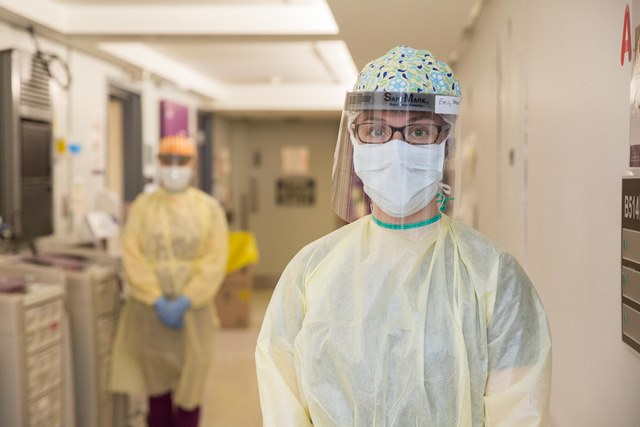
Patients who require orthopaedic and amputee rehabilitation still require these specialized services – even if they have COVID-19. Rising to meet this need, Providence Healthcare, a hospital known for its excellent rehabilitation services, opened a brand new COVID-19 positive rehab and recovery program in April designed to care for COVID-19 positive patients.

“When we were first approached about this COVID-19 unit, a lot of things ran through my mind, but the first thought was this is an emergency situation and we need to be prepared to care for our patients,” says Caroline Monteiro, the Patient Care Manager for the Orthopaedic and Amputee Rehabilitation unit on B5, which has three pods: north, south and west. She was called upon to help lead this space in the north pod.

“The team was completely on board, and there was so much support from our colleagues at St. Michael’s and St. Joseph’s. It has been wonderful to see how all of our Unity Health sites have come together in response to this pandemic.”

The rehab and recovery program provides orthopaedic and amputee rehabilitation support with safety measures in place for positive patients including an entirely isolated space with dedicated equipment and occupational therapy, physiotherapy, rehab and nursing support.

Laura Chiriac, a Registered Nurse and one of the team members who helped create the space, said she is glad to be on the team providing this type of support.

“Patients coming to us may be frail, exhausted, lonely from being away from loved ones and afraid of what’s next,” she says. “During these times, I hope that our knowledge, care and compassion will be what they need to feel supported as they get stronger and healthier.”

Monteiro echoed those comments, saying her whole team is prepared and happy to help patients so they can get back to their normal as soon as possible.

“I am so grateful for this opportunity to serve our community right now,” she says, “and for every single one of our team members for providing this important support.”

Selma Al-Samarrai is a communications advisor at Unity Health Toronto.

Latest articles

New approach opens door to better-targeted treatments and faster drug discovery for complex diseases

McGill researchers have developed an AI tool called SIDISH that identifies high-risk cancer cells driving aggressive disease, enabling more precise and targeted treatment strategies. By linking single-cell data with patient outcomes, the tool can predict disease progression and simulate responses to potential drug targets, helping accelerate drug discovery and repurposing. While still in development, SIDISH shows promise for advancing personalized cancer care and improving outcomes across multiple tumour types.

Canadian Cancer Society urges lowering colorectal cancer screening age to 45

The Canadian Cancer Society is urging provinces to lower the colorectal cancer screening age from 50 to 45, citing rising rates among younger adults and evidence that earlier screening could prevent over 15,000 cases and 6,100 deaths. Younger patients are more often diagnosed at advanced stages, making early detection critical. Expanding access to simple screening tools like FIT tests could significantly improve outcomes and save lives.

Unleashing natural killer cells against cancer

Researchers at McGill University have developed a new strategy to enhance natural killer (NK) cells, enabling them to better penetrate tumour defenses and destroy cancer cells. Using small-molecule drugs to temporarily boost NK cell activity—rather than permanent genetic modification—the approach showed strong results against multiple hard-to-treat cancers in preclinical studies. The scalable, ready-to-use therapy could make immunotherapy faster, safer, and more accessible, with future clinical trials planned for aggressive cancers like acute myeloid leukemia.

Doctors report false health information, lack of health data sharing put patient care at risk

A new CMA survey reveals major risks to patient care in Canada, with 99% of physicians reporting that disconnected health systems limit access to critical patient information and nearly half witnessing serious adverse outcomes as a result. At the same time, 97% of doctors say they have intervened to address harm caused by false or misleading online health information, including AI-generated advice. The findings highlight the urgent need for integrated digital health systems and stronger efforts to promote reliable health information.

More like this

Doctors report false health information, lack of health data sharing put patient care at risk

A new CMA survey reveals major risks to patient care in Canada, with 99% of physicians reporting that disconnected health systems limit access to critical patient information and nearly half witnessing serious adverse outcomes as a result. At the same time, 97% of doctors say they have intervened to address harm caused by false or misleading online health information, including AI-generated advice. The findings highlight the urgent need for integrated digital health systems and stronger efforts to promote reliable health information.

From Compassion to Impact: SHN Coordinator Honoured for Advancing Organ Donation

HN Summary • Sandra Ricketts-Fusca, a Patient Care Coordinator at Scarborough Health Network, has been...

Designing the future of care: Advancing an AI-enabled hospital system

HN Summary • William Osler Health System is embedding AI into its new Epic hospital...

How AI is transforming patient care in Canada—before the first visit

HN Summary • New study reveals most Canadians don’t turn to AI for mental health...

Improving Patient Experience Starts with How Teams Communicate

Healthcare teams are being asked to do more with less. Staffing shortages, rising patient...

Making Clinical Research a Care Option: How Digital Infrastructure is Expanding Access to Clinical Trials in Canada

Across Canada, there is growing recognition that clinical research should not be viewed as...