
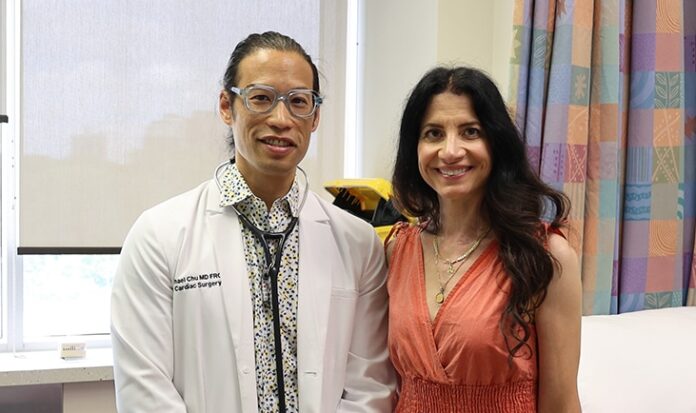

In a groundbreaking achievement for cardiac care, London Health Sciences Centre (LHSC) has become the first hospital in the world to perform two complex aortic reconstruction procedures simultaneously within a single surgery—using two innovative medical devices never before combined in this way.
The historic procedure took place in August 2024, led by LHSC Cardiac Surgeon Michael Chu and his multidisciplinary team. Together, they performed both a protected Ross operation—where a patient’s own pulmonary valve is transplanted to replace a diseased aortic valve—and a hybrid arch frozen elephant trunk procedure, an advanced technique that allows surgeons to replace a large portion of the aorta in a less invasive and highly strategic manner.
Individually, each of these procedures is considered technically demanding. Combining them into a single operation represents an unprecedented surgical milestone. The team was able to reconstruct the majority of the patient’s aorta within the chest while also restoring durable valve function—achieving in one surgery what would typically require multiple high-risk operations.
“This was an extraordinary case that demanded meticulous planning, precision, and seamless teamwork,” says Dr. Chu. “By combining these two advanced procedures, we were able to completely repair the patient’s aortic dissection while simultaneously providing long-lasting, life-enhancing valve function. It’s not only lifesaving—it significantly reduces the likelihood of future interventions.”
The achievement was made possible through both surgical expertise and technological innovation. LHSC utilized two advanced devices from Artivion, Inc.: the CryoValve Synergraft pulmonary homograft and the E-vita Open Neo hybrid stent graft system. These devices enabled the team to address extensive aortic damage while preserving and optimizing heart valve performance.
The first patient to undergo the dual procedure, Angela, had been living with a complex and life-threatening connective tissue disorder. For years, she had required ongoing cardiac care and multiple emergency surgeries. Most recently, she was facing progressive aortic dissection—a dangerous tear in the inner layer of the aorta that can be fatal if left untreated—along with significant valve degeneration.
Her case presented enormous challenges. The aorta is the body’s largest artery, responsible for delivering oxygen-rich blood from the heart to the rest of the body. Damage to this vital vessel, particularly in patients with connective tissue disorders, can rapidly escalate into a life-threatening emergency.
“The complexity of Angela’s condition required an extraordinary level of coordination and surgical expertise,” Dr. Chu explains. “This combined approach allowed us to rebuild most of her aorta and restore healthy valve function in one operation, offering a durable, long-term solution.”
For Angela, the results have been transformative.
“I can plan for the future now, which is something I couldn’t let myself do a year ago,” she says. “There’s no longer that cloud of worry over my head. I have more energy, I’m not relying on my asthma medications as much, and I feel more relaxed knowing it’s done.”
The success of this procedure offers new hope to patients with complex aortic disease, especially those with connective tissue disorders who often face repeated surgeries over their lifetime. By consolidating major interventions into a single, carefully executed operation, surgeons can reduce cumulative risk, limit recovery periods, and improve long-term quality of life.
Beyond the immediate clinical impact, this world-first accomplishment reinforces LHSC’s leadership in advanced cardiac innovation. The hospital has built a reputation for integrating cutting-edge technology with patient-centred care—ensuring that even the most complex cases receive personalized solutions.
Dr. Chu emphasizes that innovation in cardiac surgery is not solely about technical achievement, but about improving patient outcomes.
“This approach not only improves survival and quality of life,” he says, “it also provides a meaningful alternative to more invasive strategies. For patients who may otherwise have limited options, it can optimize long-term outcomes and restore life expectancy.”
As cardiac surgery continues to evolve, milestones like this demonstrate what is possible when surgical expertise, technological advancement, and compassionate care intersect. For Angela and future patients facing similarly daunting diagnoses, the procedure represents more than a medical first—it represents renewed hope.
With this achievement, LHSC has not only advanced the field of cardiac surgery but has also set a new global benchmark for what can be accomplished in a single operating room.