

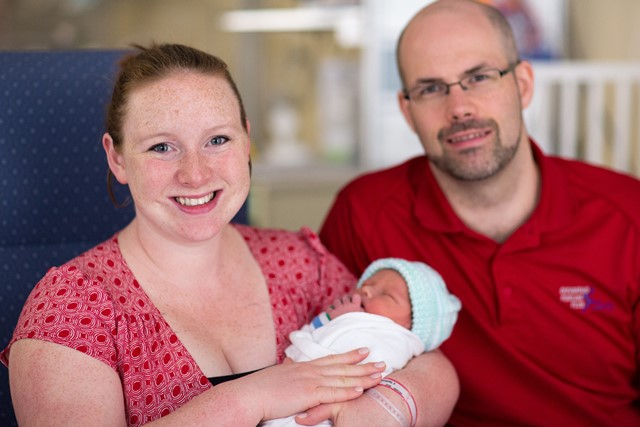

For just a moment, put yourself in Sarah Sayle’s shoes.
You’re a busy mom of two even busier girls, both under the age of two. Juggling the daily demands of an infant and a toddler, you learn there’s one more on the way. This time, a baby boy. Life’s about to get a whole lot busier.
Is your head already spinning? Few can relate, let alone imagine life with three little ones under three. Still, Sarah and her husband are prepared to take it all in stride.
Suddenly, a second wave of news strikes: Sarah, 29, who was born with a congenital heart defect, needs to have heart surgery. Her aortic valve has given out under the physical stress of pregnancy.
“I didn’t know what was going to happen,” said her husband. “She went for a doctor’s appointment in the morning, was supposed to be back by noon and instead was admitted to hospital.”
MORE: WHERE WILL THE NEXT GENERATION OF CEOS COME FROM?
Sarah needed to make a decision right away. She had three options: wait until her baby was born to have open-heart surgery, risking death for both her and/or her unborn child in the meantime; terminate the pregnancy and proceed with open-heart surgery; or undergo a specialized valve replacement while #pregnant – something that had never been done before.
Sarah’s decision was clear. At sixteen weeks pregnant, she underwent a transcatheter aortic valve implantation (#TAVI) procedure, where a new valve is inserted into the heart via an incision made in the groin. For TAVI patients, the physical stress and recovery of the surgery is minimized – the best option for those who are too frail or in unique situations such as Sarah’s.
“Our main goal was to save Sarah’s life,” says Dr. Rich Whitlock, cardiac surgeon at Hamilton General Hospital.
Although Dr. Whitlock and his team were confident that TAVI was the best option for Sarah, it took careful planning and collaboration between both the cardiac and obstetrics teams to ensure a smooth journey for both mom and baby.
“Everyone was constantly checking in on me,” says Sarah. “My obstetrician even visited me in recovery at the General to make sure everything was okay.”
Sarah recovered well from her surgery. On Sept. 22, Sarah and her family welcomed a healthy baby boy, Peter, weighing 7lbs 12oz. He spent his first few days being closely monitored by staff and physicians in the neonatal intensive care unit at McMaster Children’s Hospital before heading home to meet his two big sisters.
MORE: MAKING PATIENTS OUR PARTNERS
“Sarah’s case is something you read about in a textbook,” says Dr. Michelle Morais, obstetrician at McMaster University Medical Centre who helped to deliver baby Peter. “You maybe see it once or twice in a career.”
Dr. Morais says other health care teams will read about and learn from Sarah’s case, a world first not only due to her pregnancy, but also her age – she’s the youngest TAVI patient to date. The learnings shared between the two teams are invaluable for future TAVI and other cases. Together, they’ve exemplified the epitome of collaboration and interdisciplinary care, and the positive outcomes for both Sarah and baby Peter are proof.
“It was perfect,” says Dr. Whitlock. “It was a textbook case.”