

By Julia Hanigsberg
When you are a specialty hospital, as we are at Holland Bloorview Kids Rehabilitation Hospital, you spend a lot of time explaining what you do and sometimes it feels like we define ourselves by what we don’t do. We don’t have an emergency department. We don’t do surgery. You get the picture. But if your child has a brain injury, cerebral palsy, autism spectrum disorder, developmental delay or one of more than 1000 other unique diagnoses that have a long term or life-limiting impact, you’ll quickly learn out role in children’s healthcare and the enormous strength and courage of the children and families who we serve.
And how we do what we do is as important as what we do. We partner in extremely deep and rich ways with children and families to meet their goals in care, therapy, and life. We build on the richness of the child’s life and strengths and help that child and family take who they are and make it the best it can be. Why do we think client and family centred care is the most important thing we do? Let me give you an example.
In a recent national survey conducted by Holland Bloorview Kids Rehabilitation Hospital, 45 per cent of Canadians said that they believe kids with disabilities lead less fulfilling lives than those of typically developing kids. That’s the stigma that our clients and families face each and every day outside our walls.
But that doesn’t have to be so.
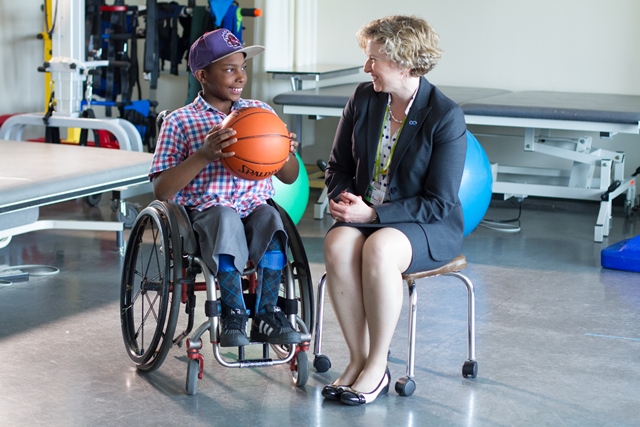
We see joyous kids every day who may not speak, or who use a walker or wheelchair to get around, but they experience friendship and love that comes from being a part of a family.
For some kids, fulfillment comes from beginning to communicate with their family through technology specially designed and customized to their needs. It might be becoming more mobile through therapy or prosthetics, less anxious or more adept at social interaction with peers. Or it might come from being able to play music with assistive devices, or from being able to paint or perform in a play.
By partnering in care, quality and patient safety with clients and families we are developing the programs, services and approaches that will enable kids with disabilities to be appreciated for their strengths and the meaning they bring to their own lives and those who love them rather than being defined by a diagnosis or what they can’t do.
Through the partnership of our research family engagement program we are conducting promising research to better understand quality of life as it relates to children and youth with disabilities. We’re exploring areas such as barriers to inclusion, employment and accessibility, friendship and life-skills development, and how all of this contributes to overall satisfaction.
So over the next six months as we develop our next strategic plan, we have families and youth at the table and we start with what we hear from families: we need to make it easier to manage the multiple services, providers and institutions their children interact with. Through research and training we need to lead to enable all elements of our health system to partner more effectively. And we need to explore how we will reduce the barriers put in the way of kids with disabilities outside our walls. Because using a wheelchair doesn’t make you disabled unless someone builds a curb in your path.
Listening to our clients and families has led to us challenging the status quo in care, research, and teaching and in the very purpose of our hospital.
Julia Hanigsberg is President and CEO, Holland Bloorview Kids’ Rehabilitation Hospital.