

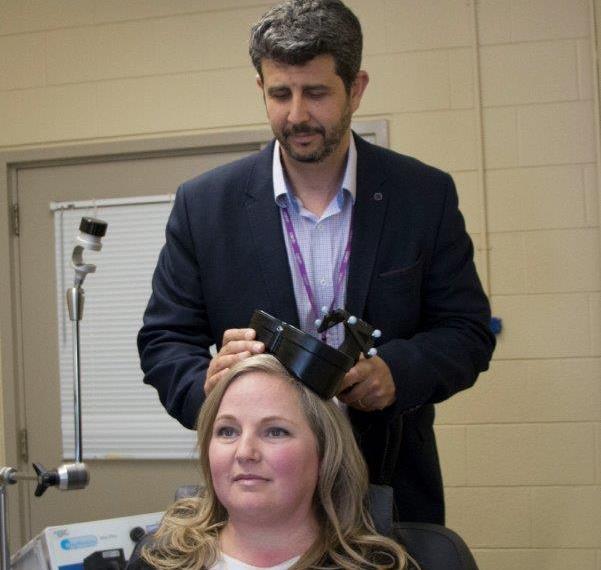
A specific kind of brain stimulation is effective in reducing suicidal thinking in a significant portion of people with hard-to-treat depression, according to a new CAMH study published in The Journal of Clinical Psychiatry. Forty per cent of people in the study reported that they no longer experienced suicidal thoughts after receiving bilateral repetitive transcranial magnetic stimulation (rTMS).
“This is one of the first large studies showing rTMS is effective in treating suicidal ideation,” says Dr. Jeff Daskalakis, senior author of the study and Co-Director of the Temerty Centre for Therapeutic Brain Intervention in CAMH’s Campbell Family Mental Health Research Institute. “The effects on suicidal ideation were independent of effects on depressive symptoms.”
The promising findings give hope that, with further evidence, rTMS may offer a new way to prevent suicide in people with hard-to-treat depression, as well as other mental illnesses. Suicidal thinking can occur in several mental illnesses, including post-traumatic stress disorder, bipolar disorder, schizophrenia and borderline personality disorder. It’s estimated that about 90 per cent of people who die by suicide have a mental illness.
While medications and psychotherapy are effective treatments for many people with mental illnesses, there’s an urgent need for new treatments that quickly and specifically reverse suicidal thinking. “One of the only effective treatments for suicidal ideation is electroconvulsive therapy or ECT,” says Dr. Daskalakis. “While ECT is the most effective treatment in psychiatric care, it’s rarely used, because of high stigma and adverse cognitive side effects associated with the treatment. Less than one per cent of patients with hard-to-treat, or treatment-resistant, depression get ECT.”
Treatment-resistant depression is defined as the condition when people do not experience a noticeable improvement in their symptoms after trying at least two different antidepressant medications. Up to 40 per cent of people with depression are treatment resistant, representing about 600,000 Canadians a year. Earlier CAMH studies have shown rTMS is an effective therapy for treatment-resistant depression.
For the new study, led by psychiatry resident Dr. Cory Weissman in the Temerty Centre for Therapeutic Brain Intervention, the researchers analyzed data from two earlier CAMH studies on rTMS given to people with treatment-resistant depression. At the start of these studies, 156 people reported that they experienced suicidal thoughts.
A non-invasive form of brain stimulation, rTMS directs magnetic pulses at a targeted area of the brain. In these studies, rTMS was applied to the dorsolateral prefrontal cortex, an area in the frontal lobes, five times a week for either three or six weeks. Participants were randomized to receive rTMS in one of three ways: to both the right and left frontal lobes (bilateral rTMS), the left frontal lobe only (unilateral rTMS) or, as a comparison group, sham rTMS, which is similar to a placebo.
Bilateral rTMS showed the biggest effect, and outperformed both other types. Forty per cent of people who received bilateral rTMS reported that they no longer experienced suicidal thoughts by the study end. By comparison, 27 per cent of those who received unilateral rTMS, and 19 per cent of those who received sham rTMS no longer experienced suicidal thoughts. Bilateral rTMS was also the most effective at preventing the development of suicidal thoughts in people who were not experiencing suicidal thinking at the start of the study.
While left unilateral rTMS is the most common type, the findings suggest that targeting the right frontal lobe may be key to treating suicidal thinking, says Dr. Weissman, first author of the study. Earlier research in people with depression and suicidal ideation has shown that this brain region may be linked with impulsivity and difficulties with regulating emotions. In future studies, the researchers plan to zero in on the right frontal lobe.
Interestingly, the decreases in suicidal thinking were not strongly linked to reductions in the severity of depression symptoms. “This suggests that suicidality is not necessarily just a symptom of depression – it may be a related, but separate entity,” says Dr. Weissman. Given that suicidal thinking occurs across multiple mental illnesses, identifying an effective treatment may prevent suicide for a broad spectrum of people with mental illnesses.