HomeMedical SpecialtiesGeriatrics and AgingCart full of fun helps seniors ACE their hospital stay

Cart full of fun helps seniors ACE their hospital stay

Published on

By James Wysotski

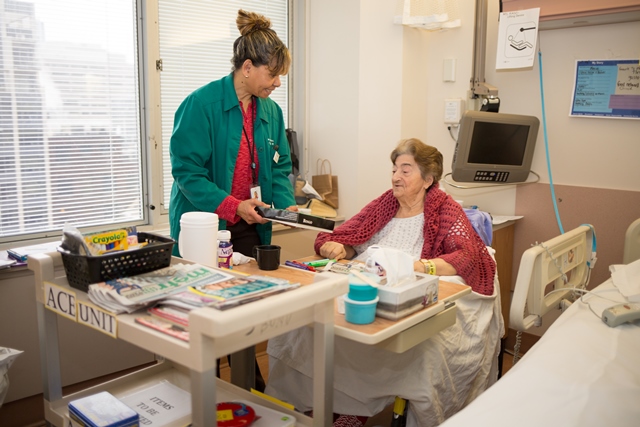
For patients on St. Michael’s Acute Care of the Elderly Unit, the new activity cart helps pass time more enjoyably.

For their caregivers, it contributes to getting the seniors home sooner.

Full of newspapers and magazines, colouring books, radios, large-print novels and games like bingo, cards and dominos, the cart features activities to stimulate the mind and keep patients engaged, said Joanna Stanley, a physiotherapist from the Regional Geriatric Program who works on the unit. In keeping with the unit’s philosophy of designing care around seniors’ needs, the cart also offers specific activities tailored to each patient, such as embroidery or knitting, if they’ve been requested.

“Some of the activities on the cart help keep the patients oriented, and that’s important because it can help prevent delirium,” says Stanley.

Along with RGP occupational therapist Lisa Vandewater and PT/OT assistant Edma Apostol, Stanley helped create the cart in November 2016, a month after the ACE Unit opened on 8 Cardinal Carter South. Created for the Volunteers Involving Seniors in Activities – or VISA – Program, which has been running at St. Michael’s for several years, the cart allows volunteers to engage patients in activities and conversation during friendly visits.

Each day, the trio sets up the cart for the volunteers and provides a list of patients for them to visit. Equipped with fresh newspapers and sometimes an iPad, the volunteers discuss current events or search for images such as places where the patients grew up. Since many of the patients have short-term memory impairments, these activities help to provide mental stimulation through reminiscence.

“It’s a good launching point for further conversations,” says Stanley. While the VISA visits help with orientation, they also improve the patients’ hospital experience.

Passing time more enjoyably is another benefit.

“Interactions with the volunteers help reduce the stress and anxiety related to being in the hospital environment,” says Vandewater.

There’s also the added benefit of more time spent sitting up or out of bed, both of which further therapy goals, says Stanley.

While many of the items on the cart were on the unit before its inception, Stanley said Volunteer Services has also been a huge support by offering funds to make rooms more senior-friendly, as well as providing new cart items to improve the patient experience.

Latest articles

New research links brain region to linguistic ability

The cerebellum, typically associated with movement, may also play a key role in reading...

Making Clinical Research a Care Option: How Digital Infrastructure is Expanding Access to Clinical Trials in Canada

Across Canada, there is growing recognition that clinical research should not be viewed as...

Privacy-First AI: How Federated Learning Is Transforming Canadian Cancer Research

Imagine training an AI model on patient data from hospitals in Vancouver, Toronto, and...

People living with Parkinson’s face long wait times, inconsistent care across Canada

Parkinson Canada launches Limitless Parkinson’s Care campaign for this Parkinson’s Awareness Month. Accessing Parkinson’s care...

More like this

Compassionate Care for Older Adults with Dementia

HN Summary • Baycrest’s interdisciplinary, resident-centred approach addresses the behavioural symptoms of dementia by identifying...

Are we entering a new era of dementia treatment?

A Q&A with Sunnybrook Neurologists Over the next five years, researchers estimate that more than...

Gene mutation in blood-forming cells may improve cancer immunotherapy results

Researchers at UHN’s Princess Margaret Cancer Centre have found that inactivation of the TET2...

Research findings could improve outcomes for critically ill patients on ventilators, study findscutting-edge geriatric care insights

A seven-year international, multi-centre clinical trial led by London Health Sciences Centre Research Institute...

New geriatric zone in the Emergency Department provides specialized care for seniors

Waiting and examination spaces in the new geriatric zone in the St. Joseph’s Emergency...

Dementia resource consultant embedded in the ED enhances care

When older adults living with dementia arrive in the Emergency Department (ED), it’s not always because of a medical emergency. Often, it’s exhaustion, stress or caregivers who simply don’t know where else to turn. That’s where the DREAM program — Dementia, Resources, Education, Advocacy and Mentorship — comes in. Launched in 2024 through a partnership between Niagara Health and the Alzheimer Society of Niagara Region, DREAM places dementia resource consultants directly in EDs to support patients and families in real time. In just a few months, the program has helped more than 300 individuals and prevented over 100 unnecessary hospital admissions by connecting families with the right community supports.