HomeNews & TopicsTechnology and InnovationMade-to-order diagnostic tests may be on the horizon

Made-to-order diagnostic tests may be on the horizon

Published on

McGill researchers demonstrate potential for on-the-spot 3D-printed tests.

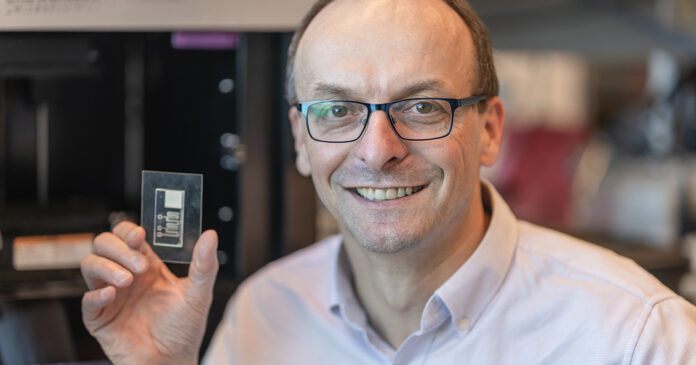
McGill University researchers have made a breakthrough in diagnostic technology, inventing a ‘lab on a chip’ that can be 3D-printed in just 30 minutes. The chip has the potential to make on-the-spot testing widely accessible.  

As part of a recent study, the results of which were published in the journal Advanced Materials, the McGill team developed capillaric chips that act as miniature laboratories. Unlike other computer microprocessors, these chips are single-use and require no external power source – a simple paper strip suffices. They function through capillary action – the very phenomena by which a spilled liquid on the kitchen table spontaneously wicks into the paper towel used to wipe it up.  

“Traditional diagnostics require peripherals, while ours can circumvent them. Our diagnostics are a bit what the cell phone was to traditional desktop computers that required a separate monitor, keyboard and power supply to operate,” explains Prof. David Juncker, Chair of the Department of Biomedical Engineering at McGill and senior author on the study. 

At-home testing became crucial during the COVID-19 pandemic. But rapid tests have limited availability and can only drive one liquid across the strip, meaning most diagnostics are still done in central labs. Notably, the capillaric chips can be 3D-printed for various tests, including COVID-19 antibody quantification.  

The study brings 3D-printed home diagnostics one step closer to reality, though some challenges remain, such as regulatory approvals and securing necessary test materials. The team is actively working to make their technology more accessible, adapting it for use with affordable 3D printers. The innovation aims to speed up diagnoses, enhance patient care, and usher in a new era of accessible testing. 

“This advancement has the capacity to empower individuals, researchers, and industries to explore new possibilities and applications in a more cost-effective and user-friendly manner,” says Prof. Juncker. “This innovation also holds the potential to eventually empower health professionals with the ability to rapidly create tailored solutions for specific needs right at the point-of-care.” 

Latest articles

New approach opens door to better-targeted treatments and faster drug discovery for complex diseases

McGill University researchers have developed an artificial intelligence tool that can identify small groups of cells most responsible...

Canadian Cancer Society urges lowering colorectal cancer screening age to 45

The Canadian Cancer Society (CCS) is calling on provinces and territories to lower the...

Unleashing natural killer cells against cancer

Researchers at McGill University have developed a new strategy to enhance natural killer (NK) cells, enabling them to better penetrate tumour defenses and destroy cancer cells. Using small-molecule drugs to temporarily boost NK cell activity—rather than permanent genetic modification—the approach showed strong results against multiple hard-to-treat cancers in preclinical studies. The scalable, ready-to-use therapy could make immunotherapy faster, safer, and more accessible, with future clinical trials planned for aggressive cancers like acute myeloid leukemia.

Doctors report false health information, lack of health data sharing put patient care at risk

Canada's doctors are concerned that false health information and disconnected health systems are putting...

More like this

HHS is first hospital in North America to ‘filter out’ blood clots

HN Summary • Hamilton Health Sciences is the first hospital in North America to trial...

Designing the future of care: Advancing an AI-enabled hospital system

HN Summary • William Osler Health System is embedding AI into its new Epic hospital...

Improving Patient Experience Starts with How Teams Communicate

Healthcare teams are being asked to do more with less. Staffing shortages, rising patient...

Still managing fax referrals manually?

Despite decades of digital transformation initiatives, one technology still dominates referral intake across hospitals...

Making Clinical Research a Care Option: How Digital Infrastructure is Expanding Access to Clinical Trials in Canada

Across Canada, there is growing recognition that clinical research should not be viewed as...

Privacy-First AI: How Federated Learning Is Transforming Canadian Cancer Research

Imagine training an AI model on patient data from hospitals in Vancouver, Toronto, and...