

By Carla Wintersgill
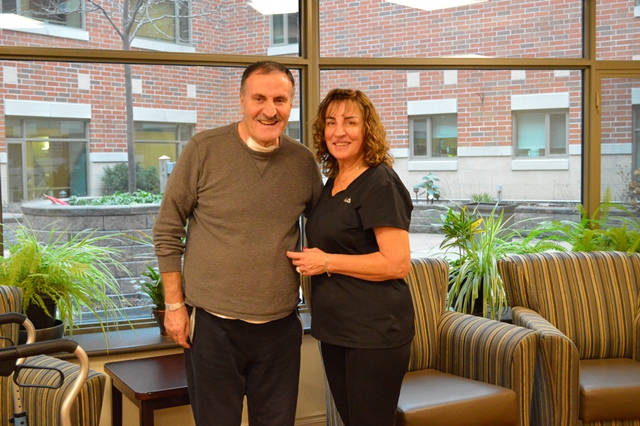
Georges Maalouf entered Runnymede Healthcare Centre’s Medically Complex program after a month in acute care following a severe stroke that rendered him completely immobile and unable to even breathe or eat solid food.
“I felt totally destroyed,” Georges says.
Runnymede’s Medically Complex program provides care for patients with multiple medical needs that may result from acute injury, chronic illnesses or disabilities. The treatment programs, rehabilitation and around-the-clock care provided by the hospital’s highly skilled clinical team goes beyond what is available to patients at home.
While his medical needs were significant, Runnymede’s interprofessional team had one unwavering vision: to get Georges home. The hospital is a site of transitional care for patients who are recovering from injury or surgery – even for highly complex patients such as Georges. By working together as one team and staying focused on the end goal, Georges was able to be successfully discharged.
“Our staff team is dedicated to providing excellent, highly individualized care,” Sharleen Ahmed, vice president of quality, strategy, and clinical programs, said. “We’re here to help patients transition to the next step in their recovery journey, whether that is home or to another facility and we are always working toward continuous improvement.”
At admission, the social work team had a big picture of Georges’s case. They identified his barriers to getting home and focused on ensuring all the pieces were in place to ready him for discharge.
The family’s expectations were high – their main goal was to see Georges back on his feet again and able to care for himself. They suffered some initial discouragement when Georges wasn’t mobile within weeks.
The social work team stepped in to restore hope to the family. They held regular meetings with Georges and his wife and were instrumental in helping keep their spirits up. They helped them to understand that the progress they were seeing was significant.
Stroke rehabilitation orientation program: Turning an inspirational idea into reality
The social work team worked with the family to help illustrate what the recovery journey ahead looked like. To achieve Georges’s end goal of full independence, a lot of mobility functions needed to be in place. Achievements such as being able to sit up were major milestones that should be celebrated.
There were two major obstacles to Georges’s discharge: mobility and tracheostomy. Working with the physiotherapy, occupational therapy and speech language pathology teams to address these challenges, the interprofessional team gathered to discuss Georges’ progress in daily rounds. They took his ultimate goal of returning home and broke it down into manageable steps.
First, his mobility was restored significantly. Georges could sit without needed support from a mechanical lift. Then his strength was built up to the point where he could use a wheelchair. Then he transitioned to a walker before being able to stand without support.
The major turning point came after the social work team made arrangements for the tracheostomy to be removed at one of Runnymede’s partner hospitals. Once it was out, the stage was set for Georges to go back home.
A year after first being admitted, Georges’s independence had not only been restored, he was able to return back to the life he wanted to lead. His long road to recovery was made possible by the dedication of a unified team’s commitment to reaching one milestone at a time.
“I look forward to seeing my grandkids,” Georges said. “I’m very optimistic about my future thanks to my care at Runnymede.”
Carla Wintersgill is a Communications Specialist at Runnymede Healthcare Centre.