


SickKids surgeons change blood flow in a vein from one-way to two-way in minimally invasive and life-changing procedure for teen.
By Vanessa Blanchard
When Linda Fedele, 17, woke on May 14, 2017, to extreme back pain, she never thought it would be over a year until she was pain-free. She certainly didn’t think the solution would be a world-first surgical procedure. On June 4, 2018, Linda became the first paediatric patient in the world to successfully undergo an innovative procedure by a team of surgeons at The Hospital for Sick Children (SickKids) to treat her rare medical problem known as nutcracker syndrome.
Nutcracker syndrome is a condition where the left renal vein, which drains blood from the kidney into the body’s main vein (called the vena cava), becomes compressed between the aorta and neighbouring superior mesenteric artery. This creates a partial blockage with pressure build-up in the left kidney, which can cause debilitating pain and hematuria (blood in the urine). This arrangement of arteries compressing the left renal vein has the appearance of a nutcracker, hence the name, nutcracker syndrome.
When Linda’s pain first started, she and her mother, Cila, spent the next several months visiting doctors’ offices, emergency departments and specialists to try to find its cause. “When I came to SickKids to be seen by a urologist, I was nervous. I had already been told by other doctors that the pain was muscular, that it would go away with time and that it was all in my head,” says Linda.
Dr. Armando Lorenzo, Staff Physician in the Department of Urology at SickKids, immediately suspected that something more serious could be happening. By the time he saw Linda, the pain she was experiencing had significantly impacted her schoolwork and ability to participate in sports. He ordered a Doppler ultrasound, which evaluates blood flow through the renal veins, to assess her kidneys. Lorenzo’s suspicious were confirmed; Linda had Nutcracker syndrome.
With a diagnosis, Lorenzo and Dr. Jessica Hannick, Fellow in the Department of Urology at SickKids at the time, set out to create a treatment plan, but complicating Linda’s case was the fact that she was born with only one kidney.
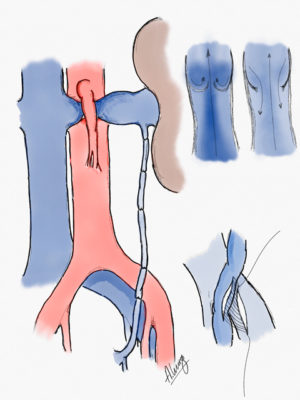
“Treatment for Nutcracker syndrome typically involves either large, open surgeries where the kidney is reconnected or by-passed to the vena cava elsewhere, or with placement of a foreign body to drain the kidney, such as a stent,” says Lorenzo. “Such invasive options held a lot of risk for Linda’s one kidney and we wanted to find a better way to alleviate the pressure in the kidney and therefore reduce her pain.”
Lorenzo enlisted the help of his colleagues, Dr. Osami Honjo, Staff Cardiac Surgeon, and Dr. Joao Amaral, Division Chief of Interventional Radiology in the Department of Diagnostic Imaging at SickKids. Together they developed a novel and minimally invasive technique that redirected blood flow from the kidney by converting a one-way vein into a two-way vein.
Before the surgery, the team identified Linda’s gonadal vein as a suitable candidate for reducing the pressure build-up in her kidney. The gonadal vein has a series of valves that maintain blood flow in one direction but the surgeons thought if they could open the valves, they might be able to allow blood to flow in two directions.
Through a small incision in Linda’s belly, Lorenzo identified the gonadal vein and Amaral inserted a small catheter to remove the gonadal vein’s valves guided by a real-time X-ray. Honjo then created a delicate connection to another vein using a technique commonly employed in cardiac surgery. Blood began to flow away from the kidney through this new pathway, decreasing the pressure and allowing the kidney to drain blood flow normally.
“The unique circumstances of Linda’s case pushed us to collaborate and find a creative solution,” says Lorenzo. “The technique we developed expands our surgical toolbox and offers a minimally invasive intervention with significantly reduced risk to other vital systems in the body. This procedure was possible thanks to the culture of collaboration at our institution, as well as the hospital’s support for innovation”
Since her procedure last June, Linda has been completely pain-free and able to resume her regular activities. She is now a swim teacher for younger kids and is applying for university like other teens her age.
“When Dr. Lorenzo came out of Linda’s surgery, he was smiling from ear to ear. He said it went perfectly and sure enough, to see her now, you would never know that she had been in so much pain before,” says Cila, Linda’s mother.
SickKids typically sees one or two patients per year with Nutcracker syndrome. The clinical team believes this condition may be underdiagnosed because the primary symptom is back pain, which can have many causes. They hope to be able to offer this procedure to more patients like Linda in the future.
Lorenzo is also Associate Professor in the Department of Surgery at the University of Toronto and Associate Scientist in Child Health Evaluative Services at SickKids.
Vanessa Blanchard is a Senior Communications Specialist at The Hospital for Sick Children (SickKids).