
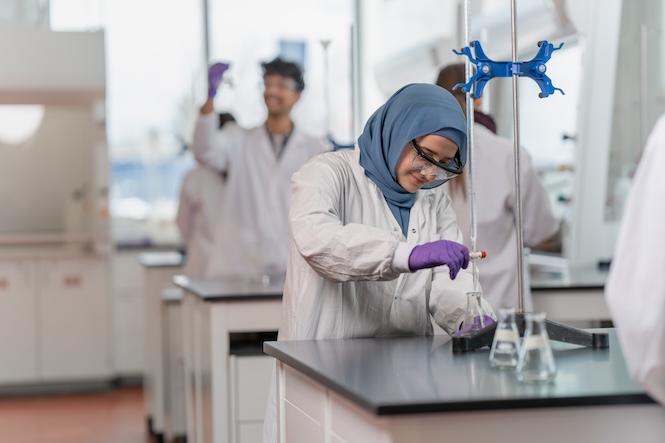

They’re energetic, they’re versatile, and they’re how healthcare organizations and hospital-linked research labs are quickly filling jobs that require highly specialized skills. They’re undergraduate students in U of T Scarborough’s Arts and Science Co-op program, and they have a decades-long track record of hitting the ground running in healthcare-related work placements.
Dr. Jeffrey Meyer, a senior scientist with the Brain Health Imaging Centre at the Centre for Addiction and Mental Health (CAMH), has been hiring U of T Scarborough Arts and Science Co-op students for more than 10 years and has no plans to stop. By hiring these students, his team gets support with a range of research tasks, from participant recruitment to data management. This way, they’re simultaneously propelling the next generation of healthcare workers and researchers by giving them a particularly valuable experience.
“Co-op students bring new perspectives and enthusiasm to the team and learn unique skills such as data analysis and participant interaction,” Meyer says. “They also help our team meet project demands while benefiting from practical experience, helping prepare them for future careers in research.”
These students, who Meyer says, “lend their keen energy to the lab environment,” arrive with skills both generally needed for the workforce and specific to the needs of medical and research projects, combining training from Canada’s top academics with eight months of career preparation courses. Whether it’s modern data management strategies from computer science, mathematics and statistics programs or research methodologies from the campus’ many health sciences programs, such as neuroscience, mental health studies, biotechnology, and immunology and disease, these students’ education also gives them the background needed to pick up new skills and adapt to the latest technologies.
Meyer recently saw that adaptability in action when he hired a U of T Scarborough Arts and Science Co-op student for a 2023 study on long COVID, published in JAMA Psychiatry. Meyer’s team used advanced brain scanning imaging agents that were developed at the Brain Health Imaging Centre at CAMH and found persistent brain inflammation in patients who experienced depression several months after getting COVID-19. The student was at first assigned to help with participant recruitment and neuroimaging data collection but ended up with a larger impact on the study.
“Initially, we expected the student to take on more administrative duties, but they quickly developed data analysis skills,” says Julie Green, research manager at the Brain Health Imaging Centre. “Their work was used in a manuscript for publication, which was recognized with an authorship.”
That’s far from the only example of a co-op student using their discipline-specific knowledge to go above and beyond researchers’ expectations. Students are frequently playing a diverse range of roles in projects — those with computer science backgrounds have done full stack web and software development for employers, and students who’ve taken courses in mathematics and statistics have contributed advanced qualitative and quantitative data analysis. Other students have worked in project management roles, with tasks such as report generation and building dashboards. Those from life sciences, health sciences and psychological sciences programs have brought their training in U of T Scarborough’s several cutting-edge labs to clinical and pre-clinical research projects, including in dry and wet lab work and participant recruitment.
In addition, four co-op students who completed their co-op terms in the Brain Health Imaging Centre were recently listed as co-authors in the first-ever study to find a natural supplement that reduces “baby blues” and post-partum depression symptoms six months after birth. These students had their names appear in The Lancet’s science journal eClinicalMedicine, after supporting research analysts in several of the project’s stages. They helped with recruiting the study’s 100+ participants, interviewing them using psychological assessment tools, storing data using clinical research software preparing material needed for the study, and attending study visits with research personnel, among other duties.
Green says this kind of “unique hands-on research experience” is how researchers can create “a mutually beneficial environment, where the student learns essential skills while also contributing to the success of ongoing research in mental health and brain imaging.”
Behind U of T Scarborough’s Arts and Science Co-op program, which is celebrating its 50th anniversary this year, is an entire department of staff dedicated to getting undergraduate students into these roles. They advise employers by connecting them with funding organizations to support their hiring. Employers can submit job descriptions (or upload them on the university’s Co-op portal), interview and choose students to be hired for four-, eight- or 12-month work terms. They can also hire co-op students from any of U of T’s three campuses, all with support from U of T Scarborough staff. To learn more about co-op at U of T, reach out to the team at uoft.me/uoftcoop
By Alexa Battler