HomeNews & TopicsWound CareFrom roots to research in advancing burn care and treatment

From roots to research in advancing burn care and treatment

Published on

Fadi Khalaf was a toddler living in Iraq with his family when U.S. forces invaded in 2003. In search of safety, his family relocated to Syria when Khalaf was five years old, followed by a move to Canada when he was eight, where they settled in Burlington.

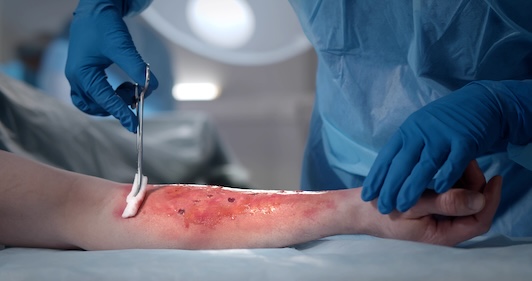
“I was very young, but those experiences shaped me into who I am,” says Khalaf, now a 23-year-old McMaster University student pursuing a master’s degree in biochemistry and biomedical sciences, with a focus on research aimed at helping burn patients. He’s investigating burns in older adults for his thesis, with an internationally recognized team of experts at the Hamilton Health Sciences (HHS) Centre for Burn Research. The team’s research focuses on developing treatments and therapies to improve outcomes in people with severe burn injuries.

Khalaf grew up listening to his family recount their experiences with explosions, traumatic injuries and limited access to health care, which inspired him to study burns and explore new and improved ways to treat them. Before starting his master’s degree, Khalaf worked for three summers at Dr. Marc Jeschke’s burns lab in Toronto and then Hamilton at the burn research centre where Jeschke’s lab is now based. Jeschke is a globally recognized burn surgeon and researcher, vice president of research for HHS and medical director of the regional burn program at HHS Hamilton General Hospital (HGH). He’s also Khalaf’s primary mentor.

The burn research centre is within the Thrombosis and Atherosclerosis Research Institute (TaARI), located in the David Braley Research Institute building. The Braley building is next door to HGH, where the Regional Burn Program is located, so researchers are right beside the patient population they’re working to help.

The HGH regional burn program is one of only two burn units in the province caring for adults with severe burns. The other is in Toronto.

The power of mentorship

 “Research has found that many older adults, including younger seniors in their 60s and in good physical shape, don’t survive burns,” says Jeschke. “We are one of few research centres in the world studying the impact of burns on older adults on cellular and molecular as well as genetic levels.”

This means that Khalaf is on the front line of cutting-edge research that could advance care for burn patients worldwide. This unique learning experience has inspired him to follow in Jeschke’s footsteps, with a career goal of becoming both a medical doctor and a researcher exploring innovative new burn treatments.

Burns and older adults

 Age-related factors that make older adults more susceptible to burn injuries include thinning skin, decreased sensation and deterioration of judgement and coordination. Yet it’s not completely understood why older adults haven’t benefited from the ongoing improvements in burn care, says Jeschke. It’s vital research, considering Canada’s aging demographic.

Over the next 20 years, Canada’s senior population is expected to grow by 68 per cent, according to the Canadian Institute for Health Information.

“It’s not just a vulnerable population; it’s also an expanding one,” adds Khalaf. “We need to start figuring out ways to mitigate these poor outcomes. Part of my project involves figuring out why older adults don’t recover well from burns, and exploring treatments and drugs that could help them respond to that trauma.” 

Latest articles

New approach opens door to better-targeted treatments and faster drug discovery for complex diseases

McGill researchers have developed an AI tool called SIDISH that identifies high-risk cancer cells driving aggressive disease, enabling more precise and targeted treatment strategies. By linking single-cell data with patient outcomes, the tool can predict disease progression and simulate responses to potential drug targets, helping accelerate drug discovery and repurposing. While still in development, SIDISH shows promise for advancing personalized cancer care and improving outcomes across multiple tumour types.

Canadian Cancer Society urges lowering colorectal cancer screening age to 45

The Canadian Cancer Society is urging provinces to lower the colorectal cancer screening age from 50 to 45, citing rising rates among younger adults and evidence that earlier screening could prevent over 15,000 cases and 6,100 deaths. Younger patients are more often diagnosed at advanced stages, making early detection critical. Expanding access to simple screening tools like FIT tests could significantly improve outcomes and save lives.

Unleashing natural killer cells against cancer

Researchers at McGill University have developed a new strategy to enhance natural killer (NK) cells, enabling them to better penetrate tumour defenses and destroy cancer cells. Using small-molecule drugs to temporarily boost NK cell activity—rather than permanent genetic modification—the approach showed strong results against multiple hard-to-treat cancers in preclinical studies. The scalable, ready-to-use therapy could make immunotherapy faster, safer, and more accessible, with future clinical trials planned for aggressive cancers like acute myeloid leukemia.

Doctors report false health information, lack of health data sharing put patient care at risk

A new CMA survey reveals major risks to patient care in Canada, with 99% of physicians reporting that disconnected health systems limit access to critical patient information and nearly half witnessing serious adverse outcomes as a result. At the same time, 97% of doctors say they have intervened to address harm caused by false or misleading online health information, including AI-generated advice. The findings highlight the urgent need for integrated digital health systems and stronger efforts to promote reliable health information.

More like this

First-in-Canada case of sustained HIV remission

HN Summary • A first-in-Canada case shows a patient achieving sustained HIV remission following a...

UHN researchers investigate new therapies as colon cancer rises among young patients

HN Summary • Colorectal cancer is rising among younger adults, prompting UHN researchers to investigate...

HHS lung cancer patient thrives thanks to research trial

HN Summary • A Nurse Practitioner (NP) pilot in Niagara Health’s ED has significantly reduced...

Robotic-assisted knee replacement surgery showing higher rate of complications

HN Summary • A large Ontario-based study found robotic-assisted total knee replacement is linked to...

A single question leads to better patient experience in the Emergency Department

HN Summary • A Nurse Practitioner (NP) pilot in Niagara Health’s ED has significantly reduced...

Osler transforms surgical wait times through innovation and leadership

HN Summary • Osler reduced surgical wait times significantly post-pandemic, now completing over 96% of...