
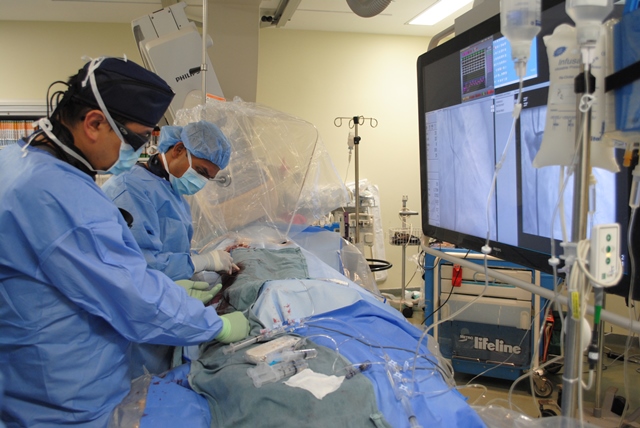


The Central East Regional Cardiac Care Centre, based at Rouge Valley Centenary hospital campus in Scarborough, is offering a new chronic total occlusion (CTO) angioplasty procedure. Patients with CTO have chronic blockages in their hearts that they could have been living with for months or even years. They might be suffering from chest pain or shortness of breath during physical activities despite medications prescribed by their cardiologist.
Robert Keene, 63, of Oshawa, was one of those patients. He could tell something was wrong. He felt different, uncomfortable, and was slowing down. “I had shortness of breath, a dull ache when exerting myself, and a very low energy level,” he says. “I thought I had indigestion, and it was very bad in the evenings,” he adds. Keene did not know that he had a CTO — in his case, a complete blockage in his heart’s right artery.
MORE: EXPANDING PAEDIATRIC CARE IN NORTHEASTERN ONTARIO
Dr. Chris Li is an interventional cardiologist with the regional cardiac care program. “Someone with a CTO can have a 100 per cent blockage in his or her heart but not have a heart attack,” he explains. “Unlike a heart attack caused by a sudden complete blockage of a major coronary blood vessel, these blockages develop slowly. When this happens over time, sometimes the heart does its own bypass and builds up collateral arteries to get blood flow around the blockage. However, these vessels aren’t big enough to keep an adequate supply of oxygen to the heart during exercise causing some patients’ lifestyles to be very limited by these symptoms.”
This inadequate supply of oxygen was causing Keene’s symptoms. His initial tests indicated the need for a percutaneous coronary intervention (PCI) — an angioplasty procedure that clears blockages in blood vessels in the heart, often using a stent. However, even after two PCIs, the artery still could not be unblocked. Fortunately, the new CTO service was available at Rouge Valley’s regional cardiac care centre. The life-changing procedure was performed on him by Dr. Li and RVHS cardiologist Dr. Ram Vijayaraghavan the following week.
“Dr. Li and Dr. Vijay were wonderful,” says Keene. “They talked to me the whole way through the procedure as I watched on the screen. They answered any questions I had right away. And, they were successful in removing the blockage,” he says.
MORE: THE PERILS OF PRIVACY BREACHES BY HOSPTIAL EMPLOYEES
As home to the Central East Regional Cardiac Care Centre serving Scarborough and Durham region, Rouge Valley’s Centenary hospital campus is depended upon for its PCI service that treats 1,500 patients a year. Starting in February 2014, the regional cardiac centre began offering the new CTO angioplasty procedure so that even more patients can be treated. Now Rouge Valley is one of a few centres in Ontario with a dedicated CTO program for regularly performing this extremely specialized procedure.
“With a normal angioplasty, we take a soft metal wire and feed it through a soft clot or blockage in an artery,” explains Dr. Vijayaraghavan. “Then, we would use this wire like a monorail and run a balloon and stent equipment along it so that we can clear the blockage. With a CTO, the artery has been 100 per cent blocked for a long time, so we cannot use traditional angioplasty wire methods to clear it. In some cases, a creative approach of passing the angioplasty wire through the collateral vessels to the ‘back door’ of the blockage, called a ‘retrograde approach,’ is used. It is like opening a blocked tunnel from both ends. Extreme care has to be taken not to damage these very fine vessels,” he explains.
The new CTO angioplasty procedure builds on the regional cardiac centre’s PCI service, and the regional fast-track emergency cardiac care program that looks to treat Scarborough and Durham patients having a heart attack in the community or at one of the partnering regional hospitals within a 90-minute window.
“CTO expands the spectrum of care that we offer,” says Dr. Li. “Our emergency cardiac program saves many lives, beyond a doubt. Now, the CTO service is life-changing for our patients. We can help these sick people who are stable, yet suffering, to improve their quality of life.”
MORE: DUTY TO PROTECT HOSPITAL STAFF FROM WORKPLACE VIOLENCE IS PARAMOUNT
This was certainly the case with Mr. Keene, who noticed an amazing difference, even right after the procedure. “My energy levels have come back to what was normal for me,” he says. “I had been slowing down for quite a few months, but now I’m back to gardening and I walk every day. It has changed my lifestyle dramatically.”
About the Central East Regional Cardiac Care Program
With a highly qualified and experienced team of more than 20 cardiologists and more than 100 health care professionals, the Central East Regional Cardiac Care Program is integrated with the community to ensure excellent, timely care. As the designated cardiac care centre for the regional program, Rouge Valley delivers care in partnership with The Scarborough Hospital, Lakeridge Health, and the Central East Local Health Integration Network (LHIN).
Each year, more than 6,500 patients from the Scarborough-Durham area are seen at the cardiac centre for a wide range of cardiac care services, including life-saving emergency and elective interventions to unblock blood vessels in the heart; advanced cardiac imaging to get a better view of what’s happening with a patient’s heart; and pacemaker and implantable cardioverter defibrillators (ICDs) and electrophysiology procedures to manage and treat arrhythmias (irregular heartbeats). The broader regional cardiac program also offers a community-based cardiovascular rehabilitation service across the Central East LHIN, working with additional partner hospitals, including Ross Memorial Hospital and Northumberland Hills.
To make a cardiologist referral to the Central East Regional Cardiac Care Centre to assess if a patient is a good candidate for the CTO program, please call 416-284-8131 ext. 5139.