

The Hospital for Sick Children (SickKids) recently celebrated the one year anniversary of Caring Safely, a strategic initiative focused on keeping paediatric patients safe from preventable events like drug errors and hospital-acquired infections. Simultaneously, the hospital is focusing on improving safety culture by implementing the principles of high reliability organizations. But with celebration comes resolve to forge ahead. As the true complexity and magnitude of this challenge is realized through increased monitoring and reporting, it’s clear that the work has really just begun.
SickKids’ focus on safety touches every corner of the hospital, connecting people from previously disparate areas in new ways. Every staff member has been asked to make a personal commitment to safety and adopt error prevention and safety behaviours to guide individual and team interactions and decision making. Since April, almost 18 per cent of staff has received safety training. Shortly after the one year Caring Safely anniversary, SickKids celebrated one year without falls causing harm.
“While we are encouraged by this milestone, our focus on implementing principles of high reliability means we are always looking for ways to improve how consistently our strategy bundle is implemented. We are striving to assess all children’s risk for falls when they are admitted, communicate that risk to other staff, post signage to remind everyone (including family) of the child’s risk to fall and ensure that appropriate strategies are being used to minimize the risk of the child falling.” says Mary McAllister, Associate Chief Nursing Practice and Clinical Lead for Falls Prevention as part of the Caring Safely initiative.
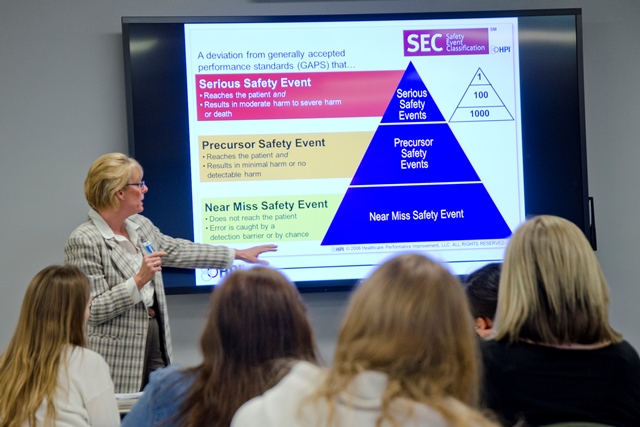
In high-reliability industries like aviation and nuclear power, near misses are not cause for celebration but a marker of an inconsistency or inadequacy in safety systems. Instead of congratulating themselves for avoiding disaster, leaders in these industries question how their safety processes did not prevent an error or catch it earlier. For SickKids, this means investigating deviations from generally accepted practice through a root cause analysis, even if the deviations didn’t result in harm to a patient. Investigating these events helps to identify the factors that together caused harm, but the challenge lies in eliminating the risks that became apparent.
SickKids was the first Canadian hospital to join Children’s Hospitals Solutions for Patient Safety, a North American collaborative of over 100 paediatric hospitals working together to improve patient safety. As a hospital that cares for children with some of the most complex cases in the country, there has been a significant focus on implementing evidence-based prevention techniques that address hospital acquired conditions such as central line associated bloodstream infections (CLABSIs).
“When it comes to CLABSI prevention, education is key and SickKids is educating all healthcare professionals involved in central line related care on best practice bundles. Sharing infection rates transparently with all clinicians is another critical component of our Caring Safely campaign” says Judy Van Clieaf, Vice President Clinical and Chief of Professional Practice and Nursing.
As the journey continues, continued collaboration is key to sustaining progress. Since SickKids joined the North American collaborative a year and a half ago, the paediatric patient safety community has grown in Canada. The Children’s Hospital of Eastern Ontario and the IWK Health Centre have joined the collaborative in recent months.
“The results from the Solutions for Patient Safety collaborative are described as some of the most exciting patient safety improvements we have seen yet. We’re forming a regional group to create deeper connections between hospitals and accelerate these developments,” says Trey Coffey, Staff Paediatrician, Paediatric Medicine and Medical Lead for the Caring Safely initiative.