
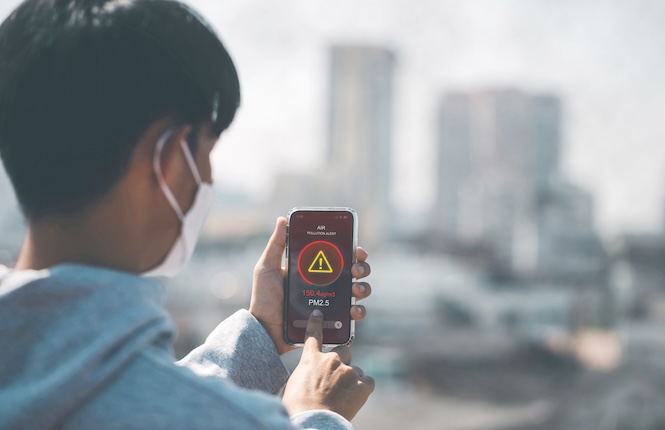

The rising number and intensity of wildfires in British Columbia are taking an immense toll on people and communities, prompting calls for further interventions to protect public health. Vancouver Coastal Health Research Institute researcher Dr. Christopher Carlsten and his team applied advanced science in the field of health outcomes to assess the cost-effectiveness of a hypothetical BC government-administered rebate on air filters to reduce smoke-related asthma complications.
Published in the prestigious American Journal of Respiratory and Critical Care Medicine, the model is designed to inform future public health discussions in the province.
“Air filters are backed by research evidence as being highly effective at reducing air pollution in the home, such as from wildfire smoke,” states Carlsten. “The missing, big-picture question is: ‘What is the most economical way to get them into peoples’ hands?’”
Wildfire smoke contains fine particulate matter with a diameter of 2.5 microns (PM2.5) – one millionth of a metre – or smaller. For comparison, a human hair is approximately 50 microns. These microscopic particles can travel deeper into the lungs, negatively impacting tissues. As a result, government health agencies often recommend that anyone with asthma or other health conditions that can worsen from fine particulate matter stay indoors during wildfire smoke events with elevated PM2.5.
Research into the long-term health outcomes of inhaling wildfire smoke is not well-established. However, short-term health implications for people with asthma, a chronic lung disease, may include increased respiratory symptoms or flare-ups, such as a worsening cough, wheezing, shortness of breath and decreased lung function, as well as other adverse health effects and hospitalizations.
A 2021 Health Canada report classified fine particulate matter as one of three leading outdoor pollutants collectively responsible for 15,300 premature deaths in Canada annually and a cost of $114 billion to Canada’s economy.
“The existing evidence suggests that traffic-related air pollution has, overall, relatively greater effects on cardiovascular outcomes than lung effects. Conversely, emerging data on wildfire smoke inhalation suggests that the respiratory system may be impacted somewhat greater than the cardiovascular system,” states Carlsten. “It is important that we understand how to protect people from wildfire smoke since the same interventions used to reduce traffic pollution effects may not apply.”
The health and economic benefits of a BC rebate program on HEPA air filters
Air filtration devices with high-efficiency particulate air (HEPA) filters can improve indoor air quality by trapping particles, including PM2.5, and reducing their overall concentrations. Tax benefits for the cost of an air filter, cleaner or purifier are currently offered through the Government of Canada, but not a rebate for a portable HEPA air filter, which can cost $150 and up.
Using a health economics approach, Carlsten and his team, including Dr. Kate Johnson as well as statistical research scientist and lead author, PhD student Amin Adibi, created a simulation model that predicted the outcomes of a five-year HEPA filter rebate program with a start and end period of 2018 to 2022.
“Wildfire smoke is a significant public health problem that is worsening. However, multiple factors can make it challenging to get a proven intervention to the people who need it.”
The research team’s analysis drew from historical data on wildfire smoke and PM2.5, as well as hospitalizations due to wildfire smoke inhalation and HEPA air filter effectiveness at removing particulate matter. Researchers also consulted with patient partners living with asthma, two medical health officers, an environmental health officer and a policy analyst.
The test scenario targeted all BC residents 42 years of age with a diagnosis of asthma and compared them with the same demographic without portable HEPA air filters in their homes. In this scenario, the BC provincial government offered a 100 per cent rebate on portable HEPA air filters to the test demographic.
“We chose conservative estimates of the HEPA air filters’ effectiveness that did not include their ability to remove other indoor sources of air particulate matter, such as cooking particles, wood burning stove smoke and pathogens,” says Adibi.
The team found that the HEPA filters could prevent more than 600 emergency room visits and 400 hospitalizations across the province. Additionally, a full rebate on the cost of a HEPA air filter was cost-effective in the Kootenay Boundary region of BC, which was also the most wildfire-prone area under analysis within the given time frame.
However, across the province, researchers found that a $100 rebate program on HEPA air filters was mostly cost-effective if each filter was used continuously throughout the year. A $30 rebate was cost-effective in wildfire-prone areas of BC’s interior and northern interior when a HEPA air filter was used only on days when PM2.5 levels exceeded 25 microns per metre squared.
“Geographic differences were a significant factor in the cost-benefit analysis of this broad-based public health intervention,” states Carlsten. “Any intervention that shows great promise at being able to improve patient outcomes should undergo a similar process when evaluating its cost-effectiveness.”