
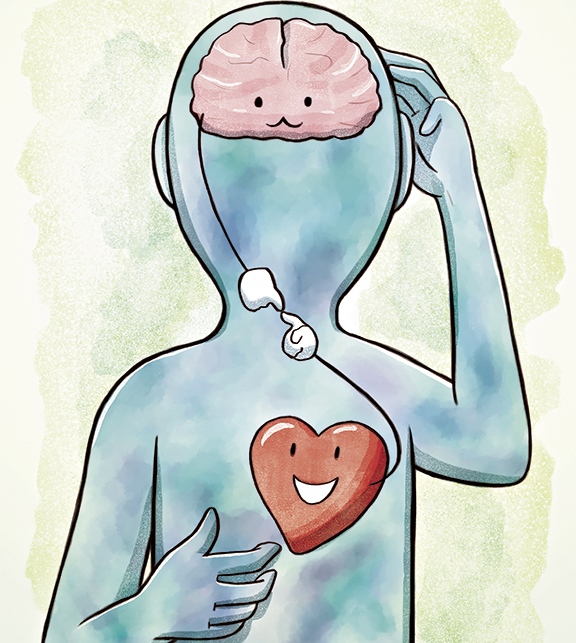

At St. Joseph’s Health Care London, the heart-brain connection is top of mind in the care of cardiac rehabilitation patients.
By Dahlia Reich
Treatment for heart disease conjures up a myriad of medical interventions – from the heroic at the time of a heart attack, to angioplasty, heart surgery or medications.
But that’s only the physical side of heart disease. Your heart and mind are always speaking to each other, and listening to their dialogue is crucial, explains Dr. Peter Prior, clinical psychologist at St. Joseph’s Hospital in London.
The ancient Greeks recognized that chest pain (angina), now known to be a symptom of coronary heart disease, had some connection to temperament. However, research into behavioural and emotional contributors to cardiovascular risk first emerged in the 1950s, and has bloomed since then, explains Dr. Prior. For example, we now also know that people with heart disease are at greater risk of certain mental health conditions, such as depression or anxiety, and science has begun to explain these linkages.
“It’s a bit of a chicken and egg question – what comes first, the psychological factors or the heart disease?” says Dr. Prior. “But the evidence says it can work in either direction. On one hand, intense or long-term stress, depression, anxiety, hostility and anger, or social isolation can each contribute to the risk of a first-time or recurrent cardiac event. This connection could operate through indirect behavioural ways like smoking, unhealthy eating or drinking to cope with stress, or through direct physiological routes, such as influences of clinical depression on heart rhythm or inflammation. On the other hand, cardiac events are often frightening and traumatic, so they can cause significant psychological suffering. There’s a two way conversation going on between heart and mind. Patients and health-care professionals alike may often overlook this.”
The evidence and role of psychology are growing in acceptance and appreciation in different areas of chronic disease management, including cardiac care. Yet many cardiac rehabilitation programs have not integrated psychological services into their care of heart patients. In matters of the heart, St. Joseph’s Health Care London is ahead of the curve. Psychological care is fully integrated into Joseph’s Cardiac Rehabilitation and Secondary Prevention Program (CRSPP).
Gaining the patient perspective through age related training
At CRSPP, men and women with known heart disease – for example, those who have had a heart attack, angina, angioplasty or heart surgery – work with the care team to create and follow an individualized program. The team is comprised of cardiologists, a cardiac rehab specialist, registered nurses, kinesiologists, a dietitian, clinical psychologist and support staff. During the six-month program, patients receive medical management, an exercise program, cardiac risk factor counselling and education sessions. Overall, CRSPP is dedicated to helping patients heal and recover (rehabilitation) from their cardiac events so that they can resume a productive, active and satisfying lifestyle, and to manage their cardiovascular risk factors to reduce the risk of recurrence (secondary prevention).
The philosophy at CRSPP is to view both rehabilitation and secondary prevention from a whole-person perspective, considering both heart and mind. All those referred to CRSPP are screened to gauge their need for psychological care, explains Dr. Prior. They may receive psychological treatment for conditions such as anxiety, depression or post-traumatic stress disorder, learn skills for stress management, approaches to enhance motivation and adherence to therapies, or to change other behaviours that increase their risk of having another heart event.
“We can take our hearts for granted,” says Dr. Prior, who edited and authored the national guidelines and contributed to the provincial standards for cardiac rehabilitation in the area of psychological and behavioural care. “For most of our lives, our hearts are extremely reliable and very strong, and we may not think about them very much until something happens. Then, an event like a heart attack or cardiac arrest can really change our basic assumptions about life. Recovery and adjustment to heart disease is a learning curve. We have good approaches to help people get through that.”
The emotional toll of heart disease can be difficult for anyone, but may be particularly heavy on younger patients, he adds. Younger people are more likely to be in the middle of their careers, supporting families, and may have to make more substantial adjustments to their new reality. It may also be their first face-to-face encounter with their mortality.
Psychologists within cardiac care programs are uniquely positioned to be well informed about cardiovascular medicine and can help patients navigate both the emotional fall-out and behaviours associated with heart disease, says Dr. Prior. “It’s very progressive for cardiac care to incorporate psychology in terms of both clinical care and research, as we do at St. Joseph’s Hospital.”
At CRSPP, psychological outcomes are systematically measured. From the time patients arrive to when they complete the program, “we see significant decreases in patients’ emotional distress and improvements in their health-related quality of life” says Dr. Prior. “It is well established in research that heart patients who participate actively in cardiac rehabilitation, compared to those who don’t, have a substantial reduction in risk of future cardiovascular events and mortality. But it’s also important to focus on the psychological health of heart patients, for its own sake.”
Long before any sign of heart disease, however, Dr. Prior’s advice is for everyone to understand the psychological and behavioural contributors to cardiovascular risk: chronic or repeated stress, whether in the workplace, family or elsewhere; clinical depression even if mild; excessive or chronic anxiety; social isolation; a pattern of anger and hostility; low fitness from lack of exercise and physical activity; smoking; unhealthy diet; poor sleep habits; or harmful use of alcohol. Research shows that for everyone, including people who have a family history or genetic background of heart disease, changing or reducing these risk factors is effective in reducing chances of heart attack.
“The thoughts we think and the emotions we feel do indeed influence our physical being, and vice versa,” says Dr. Prior. “To remain heart-healthy, or to live well with heart disease, everyone should tune into the conversation between mind and heart.”
Dahlia Reich works in Communications and Public Affairs at St. Joseph’s Health Care London.